
You don’t need a gym membership, complicated machines, or an intense fitness challenge to begin exercising.
A full body workout for weight loss can be a practical way to build strength, increase physical activity, and support long-term weight management.
Full-body routines engage several major muscle groups in one session. Depending on the exercises and pace, they may also improve cardiovascular fitness.
For beginners, bodyweight movements are particularly convenient because they require little space and no specialized equipment.
However, exercise alone does not guarantee weight loss.
Table of Contents
Body weight is influenced by nutrition, total daily activity, sleep, health conditions, and other individual factors.
The goal of this routine is to help you become more active while developing strength and confidence.
Below, you’ll find a beginner-friendly home workout featuring seven exercises, clear instructions, modifications, a weekly schedule, and a simple protein-rich snack recipe.
What Is a Full-Body Workout?
A full-body workout is an exercise session that involves several major muscle groups rather than concentrating on only one area.
For example, squats primarily work the lower body, push-ups strengthen the upper body, and bird dogs challenge core stability.
Combining these movements creates a balanced routine.
Full-body workouts can include resistance exercises, aerobic movements, or a combination of both.
How Full-Body Exercise Supports Weight Management
Physical activity increases energy expenditure and supports overall health.
Resistance exercises also help develop and maintain muscular strength.
During weight loss, strength training may help preserve lean body mass.
However, the amount of body fat lost depends on several factors beyond the workout itself.
According to the National Institutes of Health (NIH), effective weight management generally involves sustainable eating habits, physical activity, and behavioral strategies.
A home workout can be one useful part of that approach.
Why Bodyweight Exercises Are Useful for Beginners
Bodyweight exercises use your body as resistance.
Examples include squats, wall push-ups, bridges, and lunges.
These movements can be adapted to different ability levels.
For example, a beginner may perform a shallow squat while holding a sturdy chair, then gradually increase the movement range as strength improves.
The ability to modify exercises makes bodyweight training accessible to many adults.
Benefits of a Full Body Workout for Weight Loss
Builds Strength Across Major Muscle Groups
A balanced full-body routine can train the legs, hips, chest, shoulders, back, and core.
Developing strength supports everyday activities such as climbing stairs, carrying groceries, and getting up from a chair.
Regular resistance exercise can also support muscle maintenance during weight management.
Supports Cardiovascular Fitness
Some full-body workouts include continuous or repeated movements that increase breathing and heart rate.
Standing marches, side steps, and similar activities can contribute to aerobic activity.
The cardiovascular effect depends on exercise intensity, duration, and individual fitness.
Makes Exercise More Convenient
A home full-body workout removes several common barriers to exercise.
You may not need to travel, purchase equipment, or follow a gym schedule.
A short routine can fit into a lunch break or another convenient part of your day.
Helps Develop Consistent Activity Habits
Consistency is important for maintaining fitness improvements.
A realistic routine performed regularly is generally more useful than an overly demanding plan that is quickly abandoned.
Start with a schedule you can maintain and build gradually.
Before You Start: Workout Safety and Preparation
Before exercising, choose a clear space with a stable, nonslip surface.
Wear comfortable clothing and supportive footwear if appropriate.
Keep water available.
Begin with a gentle warm-up, such as easy marching, shoulder rolls, and controlled arm movements.
Exercise should feel appropriately challenging without causing sharp pain.
Stop if you experience chest pain, severe breathlessness, dizziness, or faintness.
Seek urgent medical care for concerning symptoms.
People with cardiovascular disease, significant joint problems, recent injuries, or other medical conditions may need individualized guidance before starting a new routine.
If you have been inactive for a long time, begin with shorter sessions.
25-Minute Full Body Workout for Weight Loss at Home
This beginner routine uses seven simple movements.
You can perform it without weights or gym machines.
The goal is controlled movement and manageable effort rather than maximum speed.
Workout Overview
| Workout Detail | Recommendation |
|---|---|
| Workout Type | Full-body bodyweight circuit |
| Experience Level | Beginner |
| Equipment | None required |
| Warm-Up | 5 minutes |
| Main Workout | Approximately 15–20 minutes |
| Cooldown | 3–5 minutes |
| Total Duration | Approximately 25–30 minutes |
| Exercises | 7 |
| Starting Frequency | 2–3 nonconsecutive days weekly |
| Intensity | Light to moderate, adjusted individually |
Suggested Circuit Structure
Perform each exercise for approximately 30 seconds.
Rest for 20–30 seconds between exercises.
Complete two rounds initially.
Rest for 60–90 seconds between rounds if needed.
A two-round circuit generally takes about 14–16 minutes, depending on transition and rest times.
With a warm-up and cooldown, the complete session takes approximately 22–26 minutes.
Beginners may start with one round.
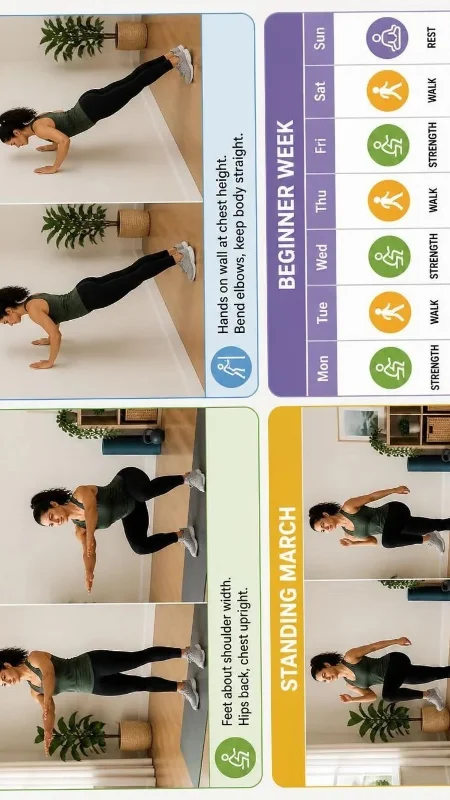
Exercise 1: Bodyweight Squats
Primary muscles: Quadriceps, glutes, and other lower-body muscles.
Squats strengthen muscles used when sitting, standing, and climbing stairs.
How to Perform
- Stand with your feet approximately shoulder-width apart.
- Keep your chest comfortably upright.
- Bend at the hips and knees as though sitting into a chair.
- Lower only as far as you can comfortably control.
- Push through your feet to return to standing.
Suggested duration: 30 seconds.
Beginner modification: Perform sit-to-stand movements using a sturdy chair.
Avoid forcing a deep squat if it causes discomfort.
Exercise 2: Wall Push-Ups
Primary muscles: Chest, shoulders, and triceps.
Wall push-ups provide an accessible alternative to floor push-ups.
How to Perform
- Stand facing a wall.
- Place your palms against the wall at approximately shoulder height.
- Step your feet back slightly.
- Bend your elbows and move your chest toward the wall.
- Push gently back to the starting position.
Suggested duration: 30 seconds.
Keep your body aligned and avoid excessive lower-back arching.
Beginner modification: Stand closer to the wall to reduce difficulty.
Exercise 3: Alternating Reverse Lunges
Primary muscles: Quadriceps, glutes, and hamstrings.
Reverse lunges challenge leg strength and balance.
How to Perform
- Stand upright with your feet hip-width apart.
- Step one foot backward.
- Bend both knees slightly while maintaining control.
- Push through the front foot to return to standing.
- Repeat on the opposite side.
Suggested duration: 30 seconds.
Beginner modification: Hold a sturdy chair for balance or perform shallow backward steps without lowering into a full lunge.
If lunges aggravate knee or hip discomfort, substitute supported squats or sit-to-stands.
Exercise 4: Glute Bridges
Primary muscles: Glutes and hamstrings.
Glute bridges strengthen muscles involved in hip extension.
How to Perform
- Lie on your back with your knees bent.
- Place your feet flat on the floor.
- Keep your arms comfortably beside your body.
- Tighten your abdominal muscles gently.
- Lift your hips until your body forms a comfortable line from shoulders to knees.
- Lower slowly.
Suggested duration: 30 seconds.
Avoid lifting so high that your lower back arches excessively.
Beginner modification: Use a smaller range of motion.
Exercise 5: Standing Marches
Primary focus: Light aerobic activity, hip flexors, and balance.
Standing marches can raise your heart rate without jumping.
How to Perform
- Stand tall with your feet hip-width apart.
- Lift one knee to a comfortable height.
- Lower it and repeat with the opposite leg.
- Swing your arms naturally if comfortable.
- Continue at a controlled pace.
Suggested duration: 30 seconds.
Beginner modification: Hold a stable surface or march more slowly.
You can increase the pace gradually as your fitness improves.
Exercise 6: Bird Dogs
Primary muscles: Core stabilizers, back muscles, and glutes.
Bird dogs challenge coordination and trunk stability.
How to Perform
- Begin on your hands and knees.
- Position your hands beneath your shoulders and knees beneath your hips.
- Gently brace your abdominal muscles.
- Extend one arm and the opposite leg.
- Pause briefly without twisting your torso.
- Return to the starting position and switch sides.
Suggested duration: 30 seconds.
Beginner modification: Extend only one arm or one leg at a time.
If kneeling is uncomfortable, perform a standing version while holding a sturdy countertop.
Exercise 7: Standing Side Steps
Primary focus: Hip muscles and light aerobic activity.
Side steps add gentle lateral movement to the routine.
How to Perform
- Stand with your knees slightly bent.
- Step to the right.
- Bring your left foot toward your right foot.
- Repeat in the opposite direction.
- Continue moving from side to side.
Suggested duration: 30 seconds.
Beginner modification: Take smaller steps and use a slower pace.
Keep your movements controlled.
How to Structure Your Weekly Workout Routine
A weight loss workout routine should balance exercise, recovery, and everyday movement.
The U.S. Physical Activity Guidelines recommend that adults aim for at least 150 minutes of moderate-intensity aerobic activity each week.
Adults should also perform muscle-strengthening activities on at least two days weekly.
The following schedule provides one possible starting point.
| Day | Suggested Activity |
|---|---|
| Monday | Full-body workout |
| Tuesday | 20–30 minutes of comfortable walking |
| Wednesday | Rest or gentle mobility |
| Thursday | Full-body workout |
| Friday | Walking, cycling, or another enjoyable activity |
| Saturday | Optional light activity |
| Sunday | Rest or gentle stretching |
This sample schedule may not reach the full recommended amount of weekly aerobic activity.
Gradually increase activity when appropriate.
For more options, explore our exercise for weight loss guide.
How Many Calories Does a Full-Body Workout Burn?
Calorie expenditure varies considerably.
Important factors include body size, fitness level, exercise intensity, workout duration, and the amount of rest between movements.
A 25-minute beginner bodyweight workout will generally burn fewer calories than a longer, vigorous session for the same individual.
However, precise calorie estimates are difficult without individual measurements.
Fitness watches and online calculators provide estimates rather than exact values.
A workout does not need to burn a particular number of calories to be beneficial.
Improving strength, cardiovascular fitness, mobility, and consistency can support health even when weight changes are modest.
How to Make Your Workout More Effective Over Time
As your fitness improves, exercises may begin to feel easier.
This is a normal training adaptation.
To continue developing fitness, you can gradually adjust the routine.
For example, you might increase work intervals from 30 to 40 seconds, complete an additional circuit, or use slightly more challenging exercise variations.
Change only one or two elements at a time.
Increasing difficulty too quickly can increase fatigue and the risk of injury.
You can also combine bodyweight training with enjoyable aerobic activities.
Walking and cycling are useful options.
If you prefer cycling, our exercise bike for weight loss guide offers additional information.
For broader fitness guidance, visit our exercise and fitness resources.
Healthy Post-Workout Greek Yogurt Berry Bowl Recipe
A balanced eating pattern supports recovery and overall health.
After exercise, protein contributes to muscle repair and maintenance, while carbohydrates help replenish energy.
For many people, a regular meal is sufficient after a moderate workout.
You do not necessarily need a special supplement or immediate post-workout snack.
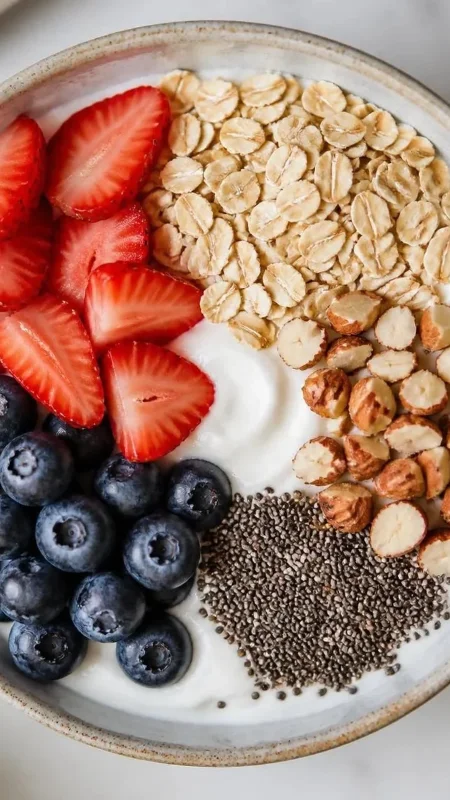
However, if you are hungry or need a convenient meal, this Greek yogurt berry bowl is a simple option.
Recipe Overview
| Detail | Information |
|---|---|
| Recipe Name | Greek Yogurt Berry Protein Bowl |
| Prep Time | 5 minutes |
| Cook Time | 0 minutes |
| Total Time | 5 minutes |
| Servings | 1 |
| Course | Breakfast or Snack |
| Cuisine | American-inspired |
| Cooking Method | No-cook |
| Difficulty | Easy |
| Main Protein Source | Greek yogurt |
Ingredients
| Ingredient | Quantity |
|---|---|
| Plain nonfat Greek yogurt | ¾ cup (approximately 170 g) |
| Fresh blueberries | ½ cup |
| Fresh strawberries | ½ cup, sliced |
| Rolled oats | ¼ cup (approximately 20 g) |
| Chia seeds | 1 teaspoon |
| Chopped almonds | 1 tablespoon |
| Ground cinnamon | ¼ teaspoon |
| Honey | 1 teaspoon, optional |
Step-by-Step Instructions
Step 1: Prepare the Fruit
Wash the blueberries and strawberries thoroughly under running water.
Remove the strawberry stems and slice the strawberries.
Step 2: Add the Yogurt
Spoon the Greek yogurt into a serving bowl.
Spread it evenly across the bottom.
Step 3: Add the Oats
Sprinkle the rolled oats over the yogurt.
Use oats labeled gluten-free if gluten avoidance is medically necessary.
Step 4: Add the Berries
Arrange the blueberries and sliced strawberries over the oats.
Step 5: Add the Toppings
Sprinkle the chia seeds, chopped almonds, and cinnamon over the bowl.
Add honey if desired.
Step 6: Serve
Enjoy immediately.
For a softer oat texture, refrigerate the assembled bowl for approximately 15–30 minutes before eating.
Estimated Nutrition Per Serving
The following estimates exclude optional honey.
| Nutrient | Estimated Amount |
|---|---|
| Calories | 300 kcal |
| Protein | 23 g |
| Carbohydrates | 36 g |
| Fiber | 7 g |
| Total Fat | 8 g |
| Saturated Fat | 1 g |
| Sodium | 70 mg |
These figures are approximate.
Actual values vary with yogurt brand, oat composition, fruit size, and ingredient measurements.
Recalculate using USDA FoodData Central or validated nutrition software before publishing precise nutrition information.
Adding one teaspoon of honey contributes approximately 21 additional calories and 6 g of carbohydrates.
Why This Recipe Works as a Balanced Snack
Greek yogurt provides protein.
Berries contribute carbohydrates, fiber, and a variety of vitamins and plant compounds.
Oats provide additional carbohydrates and fiber.
Chia seeds and almonds contribute unsaturated fats and other nutrients.
Together, these ingredients create a convenient meal or snack.
However, the recipe does not directly cause weight loss.
Its role depends on your overall eating pattern and individual nutritional needs.
Food Safety and Storage
Use pasteurized dairy products.
Keep Greek yogurt refrigerated at 40°F (4°C) or below.
Wash fruit before preparation.
Do not leave the prepared bowl unrefrigerated for more than two hours, or more than one hour when temperatures exceed 90°F (32°C).
For best quality, prepare the bowl shortly before serving.
If making it ahead, keep the ingredients covered and refrigerated.
The berries may release moisture, and the oats will soften over time.
Allergen information: This recipe contains milk and tree nuts. Substitute ingredients as appropriate for allergies or dietary requirements.
Because this recipe does not contain meat, poultry, or eggs requiring cooking, a chicken cooking temperature is not relevant to its preparation.
For reference, USDA food safety guidance specifies a minimum internal temperature of 165°F (74°C) for chicken and other poultry.
Common Full-Body Workout Mistakes
Moving Too Quickly
Rushing exercises can reduce movement control.
Focus on steady repetitions and good technique before increasing speed.
Skipping the Warm-Up
A short warm-up gradually increases movement and prepares you for more demanding activity.
Begin with easy movements before starting the main circuit.
Training Hard Every Day
Muscles and other tissues need time to recover.
Beginners generally benefit from spacing challenging full-body strength sessions across nonconsecutive days.
Expecting Exercise to Target Belly Fat
Exercises strengthen the muscles they train, but they do not reliably remove fat from a specific body area.
Body fat changes occur through broader physiological processes.
Focusing Only on Calories Burned
Calorie expenditure is only one part of exercise.
Strength, endurance, mobility, sleep, and mental well-being are also valuable outcomes.
Frequently Asked Questions
Is a Full Body Workout Good for Weight Loss?
Yes, full-body workouts can support weight management by increasing physical activity and helping maintain muscular strength.
However, weight loss is influenced by nutrition, activity, and individual health factors.
No workout guarantees a particular amount of fat loss.
Can Beginners Do Full-Body Workouts Every Day?
Beginners can be physically active every day, but challenging full-body resistance workouts generally benefit from recovery time.
Two or three nonconsecutive strength sessions per week can be a practical starting point.
Gentle walking or mobility activities may be suitable between sessions.
Is a 25-Minute Workout Enough?
A 25-minute workout can contribute meaningfully to weekly physical activity.
Whether it meets your overall needs depends on frequency, intensity, and other activity throughout the week.
The general adult recommendation is at least 150 minutes of moderate-intensity aerobic activity weekly, alongside muscle-strengthening activities.
Can You Lose Weight With Bodyweight Exercises Alone?
Bodyweight exercises can support strength and energy expenditure.
Whether weight loss occurs depends on overall energy balance and individual factors.
A balanced eating pattern and consistent activity are generally more useful than relying on a single exercise method.
Do You Need Equipment for a Full-Body Workout?
No.
Squats, wall push-ups, bridges, bird dogs, and other bodyweight exercises can train several major muscle groups.
Equipment may become useful as strength improves, but it is not required to begin.
Should You Eat Immediately After Exercising?
Not necessarily.
For most people completing a moderate workout, eating a balanced meal within their usual routine is sufficient.
People performing long or demanding training sessions may have different recovery needs.
Final Thoughts
A full body workout for weight loss can be a practical starting point for improving fitness at home.
You do not need expensive equipment or complicated movements.
Simple exercises such as squats, wall push-ups, bridges, and standing marches can help build strength and increase daily activity.
Start with a manageable routine, prioritize movement quality, and allow time for recovery.
As your fitness improves, increase the challenge gradually.
Combine regular physical activity with balanced nutrition, adequate sleep, and realistic expectations.
The most useful workout is one that supports your health and fits consistently into your life.