
You’re wiped out. Your eyes feel heavy, your body wants to power down, and you tell yourself, Tonight I’m going to sleep the second my head hits the pillow. Then it happens again: you climb into bed and your brain starts sprinting. You remember something you forgot to do. You replay a conversation. You worry about tomorrow. Minutes turn into an hour, and the frustration gets louder than your tiredness.
Table of Contents
If that sounds like your nights lately, you’re not alone—and you’re not “bad at sleeping.” Most of the time, you’re dealing with a system that’s overstimulated: too much light, too much stress, inconsistent timing, or habits that accidentally teach your brain that bed is a place for thinking instead of drifting off.
This guide walks you through how to sleep fast using practical, research-backed steps you can use tonight, plus long-term routines that make falling asleep easier week after week.
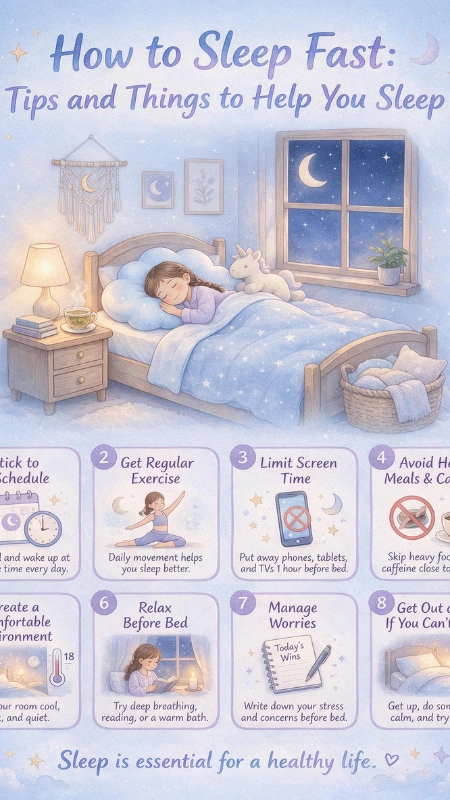
Why You Can’t Fall Asleep (and What “Sleeping Fast” Really Means)
Before you change anything, it helps to reset expectations. “Sleeping fast” doesn’t mean you should be unconscious in 30 seconds. For many adults, falling asleep in roughly 10–20 minutes is common. If you regularly lie awake for 30+ minutes and it’s stressing you out, that’s when targeted strategies matter.
What keeps you awake in the first place
Usually it’s not one big issue—it’s a stack of small ones:
- Stress and mental overdrive: Your nervous system stays in “on” mode.
- Too much light at night: Bright bulbs and screens can delay your body’s sleep signals.
- Caffeine timing: Caffeine can linger longer than you think.
- Alcohol: It may make you sleepy at first but often disrupts the second half of the night.
- Irregular schedule: Sleeping in on weekends can shift your internal clock.
- Bedroom problems: Heat, noise, or light can keep you hovering in light sleep.
- Possible medical contributors: sleep apnea, reflux, chronic pain, restless legs, anxiety, depression.
If your sleep issues are persistent or severe, you’ll find a “when to get help” section later. For now, let’s focus on what you can do immediately.
How to Sleep Fast Tonight: A Quick-Start Plan (10–30 Minutes)
If you want results tonight, you need a plan that calms your body first, then quiets your mind. Use these steps in order.
Step 1: Do a 2-minute “body downshift”
Your goal is to signal safety and slowing down.
- Dim your lights right away. Think warm and low, not bright and white.
- Put your phone on Do Not Disturb (or leave it across the room).
- Sit on the edge of your bed and take slow breaths with a longer exhale than inhale.
A simple pace:
- Inhale through your nose for 4
- Exhale slowly for 6–8
- Repeat for 10–12 breaths
Longer exhales help shift your body toward a calmer state. You’re basically telling your nervous system, “Stand down.”
Step 2: Pick one breathing method (don’t overthink it)
Breathing techniques work best when you stick to one for a few nights rather than switching every 60 seconds. Choose one based on how you feel.
Option A: 4-7-8 breathing (great for restlessness)
- Inhale through your nose for 4
- Hold for 7
- Exhale slowly for 8
- Repeat 4 rounds
If holding your breath feels uncomfortable, shorten the hold. The calming effect comes mainly from the slow exhale.
Option B: Box breathing (good for mental control)
- Inhale 4
- Hold 4
- Exhale 4
- Hold 4
Repeat for 2–4 minutes.
Option C: The “physiological sigh” (fast reset when you feel wired)
- Inhale through your nose
- Take a second quick inhale to “top off”
- Exhale long and slow through your mouth
Repeat 3–6 times.
This is especially helpful when your chest feels tight or your thoughts are racing.
Step 3: Use the “cognitive shuffle” if your mind won’t stop talking
When your brain spins stories at night, you can interrupt the pattern with something intentionally boring.
Try this:
- Pick a random word like “chair.”
- In your mind, list objects that start with the same letter: C—cat, candle, carpet, cereal…
- Keep it neutral and pointless (that’s the point).
You’re giving your brain “static” so it can’t build a worry narrative.
Step 4: If you’re awake after about 20 minutes, get out of bed
This sounds annoying, but it prevents your bed from becoming a place your brain associates with struggle.
Do this instead:
- Leave the bedroom or sit in a chair with low light
- Do something calm: a paper book, gentle stretching, a quiet puzzle
- Go back to bed when your eyelids feel heavy
This approach comes from CBT-I (Cognitive Behavioral Therapy for Insomnia), which is widely considered a top evidence-based treatment for insomnia.
Best Sleep Hygiene Habits That Help You Sleep Fast (Long-Term Fixes)
Quick techniques are great, but the real win is setting your day up so sleep happens more naturally.
Anchor your schedule with a consistent wake time
If you want to fall asleep faster at night, wake up at the same time most days—yes, even weekends when you can.
Why it helps:
- Your body runs on rhythms. A stable wake time helps set your internal clock.
- A regular schedule builds stronger sleep pressure at night.
If you’re currently all over the place, adjust gradually:
- Shift your wake time earlier by 15–30 minutes every few days.
Manage caffeine like it actually matters (because it does)
Caffeine doesn’t just affect you for an hour. Many people feel it much longer, especially if you’re sensitive or stressed.
Helpful rules:
- Stop caffeine 8–10 hours before bed if you’re struggling.
- Watch “hidden caffeine” (tea, pre-workout, chocolate, some sodas).
- If you must have something warm at night, go decaf or herbal.
Alcohol: the sneaky sleep disruptor
Alcohol can make you sleepy early, but it often:
- Reduces sleep quality
- Increases nighttime wake-ups
- Can worsen snoring and breathing issues
If you drink, consider:
- Keeping it earlier in the evening
- Limiting quantity
- Drinking water alongside it
Turn your bedroom into a sleep cue, not a second office
If you work, scroll, snack, and stress in bed, your brain learns: bed = activity. You want bed = off switch.
Try this:
- Keep your bed for sleep and intimacy
- Charge your phone away from the bed
- Make your room feel like a cave: cool, dark, quiet
Light exposure: the overlooked switch for falling asleep fast
Light is one of the strongest signals for your circadian rhythm.
Do two things consistently:
- Morning light: Get outside within an hour of waking for 10–20 minutes if possible.
- Evening dimming: Lower lights 1–2 hours before bed. Reduce screen brightness and avoid blasting your eyes with overhead lights.
You don’t have to be perfect. You just need to be consistent enough that your body starts predicting sleep.
Relaxation Techniques to Sleep Fast (Mind + Body)
If you’re tired but “wired,” you need techniques that drain tension from your body and reduce mental noise.
Progressive Muscle Relaxation (PMR)
PMR works because it helps you notice and release tension you didn’t realize you were holding.
A simple version:
- Start with your feet: tense for 5 seconds, release for 10.
- Move upward: calves, thighs, glutes, stomach, hands, arms, shoulders, face.
- Keep your breathing slow.
If you clench your jaw or raise your shoulders during the day, PMR can feel like turning off a motor.
Guided imagery or sleep meditation
Some nights, silence makes your thoughts louder. Guided audio can give your attention somewhere safe to rest.
Tips that make it work better:
- Choose one voice/track and reuse it (familiarity becomes a cue).
- Keep it 10–20 minutes.
- Use a sleep timer so it doesn’t play all night.
Journaling: stop the mental spiral before it starts
You don’t need a perfect journal practice. You need a short one that clears the mental desk.
“Brain dump” (2–5 minutes)
Write everything on your mind—unfinished tasks, random worries, reminders. No structure.
“Worry list + next step”
For each worry, write one next action you can take tomorrow. Example:
- Worry: “I’m going to mess up the meeting.”
- Next step: “Draft 3 bullet points for the opening and print them.”
This turns vague stress into something your brain can release.
Things to Help You Sleep Fast (Tools, Products, and Bedroom Upgrades)
You don’t need gadgets to sleep, but the right tools can remove common obstacles.
Sound: white noise, pink noise, and earplugs
If you wake up to every small sound—neighbors, traffic, a barking dog—sound masking can help.
Options:
- White noise: consistent static-like sound that covers sudden spikes
- Pink noise: often perceived as softer (more like rainfall)
- Earplugs: useful if you can tolerate them comfortably
The goal isn’t “silence.” It’s stability.
Light control: blackout curtains and eye masks
Even small amounts of light can keep you lighter in sleep.
Try:
- Blackout curtains for streetlights and early sun
- A comfortable eye mask if you can’t fully darken the room
- Warm, low lamps instead of bright overhead lighting
Temperature: a huge factor people ignore
Many people fall asleep faster in a slightly cool room.
Try:
- A fan or breathable sheets
- Lightweight bedding you can layer
- A cooling mattress pad if you run hot
If you wake at 3 a.m. sweaty and irritated, temperature is worth fixing.
Supplements (safety-first)
Supplements can help some people, but they’re not magic and they can interact with medications.
Common options:
- Melatonin: best for shifting your sleep timing (jet lag, night owls), not for knocking you out.
- Magnesium glycinate: often used for relaxation; evidence is mixed, but some people feel benefits.
- L-theanine: calming for some; research is still emerging.
If you’re pregnant, have a medical condition, or take medications, talk to a clinician first.
Bedtime Drinks and “Sleep Fast” Snack Ideas (With Recipes Table)
Food won’t support insomnia, but the right bedtime snack or drink can support a calm routine—especially if you’re the type who can’t sleep when you’re hungry.
What helps (and what to avoid)
Helpful:
- Small snack with carbs + protein (think banana + nut butter)
- Caffeine-free warm drink (ritual matters)
Avoid:
- Heavy, greasy meals late
- Spicy foods if you get reflux
- Huge drinks right before bed (hello, midnight bathroom trips)
Recipe 1: Warm “Sleepy” Herbal Tea Latte (Caffeine-Free)
| Ingredient | Amount | Notes |
|---|---|---|
| Chamomile tea bag | 1 | Or lemon balm/rooibos |
| Warm milk (dairy or oat) | 1 cup | Warm, not boiling |
| Honey | 1 tsp | Optional |
| Cinnamon | 1 pinch | Optional |
How to make it:
- Steep the tea for 5–7 minutes.
- Warm your milk separately and combine.
- Sip slowly 30–60 minutes before bed.
Recipe 2: Tart Cherry “Nightcap” Mocktail
| Ingredient | Amount | Notes |
|---|---|---|
| Tart cherry juice | 1/2 cup | Look for low added sugar |
| Sparkling water | 1/2 cup | Optional |
| Lime | 1 wedge | Optional |
| Ice | As needed | Optional |
How to make it:
- Pour tart cherry juice over ice, top with sparkling water.
- Add lime if you want a brighter taste.
Tart cherry is often discussed in sleep circles because it can contain small amounts of melatonin, though content varies by product and the research is mixed. Treat it as a gentle support, not a supports.
Recipe 3: Banana-Almond “Sleep Snack”
| Ingredient | Amount | Notes |
|---|---|---|
| Banana | 1 small | |
| Almond butter | 1 tbsp | Or peanut butter |
| Pumpkin seeds | 1 tsp | Optional topping |
| Cinnamon | 1 pinch | Optional |
How to make it:
- Slice the banana, spread nut butter, sprinkle toppings.
- Keep the portion small—this is a nudge, not a meal.
What Not to Do If You Want to Sleep Fast
Sometimes the biggest improvements come from removing the stuff that quietly wrecks your nights.
Don’t “try harder” to sleep
The harder you chase sleep, the more pressure you create—and pressure keeps you alert. Replace “I have to sleep now” with “I’m going to rest my body.” That shift alone can take the edge off.
Don’t watch the clock
Clock-watching turns your bed into a math problem. Turn the clock away or keep your phone out of reach.
Don’t scroll “just a little”
It’s rarely “a little.” Even neutral content keeps your brain engaged, and emotional content (news, arguments, dramatic videos) cranks you up.
Don’t do intense workouts too late (if it revs you up)
Exercise is great for sleep overall, but if late-night high-intensity workouts leave you energized, move them earlier or switch to gentle movement at night.
When Fast Sleep Problems May Be a Medical Issue
If you’re doing many of the right things and sleep still feels impossible, don’t assume it’s a personal failure. Sometimes there’s a treatable condition underneath.
Consider talking to a professional if you notice:
- Loud snoring, choking, or gasping at night (possible sleep apnea)
- Uncomfortable leg sensations that urge you to move (restless legs)
- Insomnia at least 3 nights/week for 3+ months
- Mood changes, panic symptoms, or depression
- Daytime sleepiness that affects driving or work
Also worth knowing: CBT-I (Cognitive Behavioral Therapy for Insomnia) is one of the most effective, evidence-based treatments for chronic insomnia. If you’ve been stuck for months, it can be a game-changer.
FAQ: How to Sleep Fast (Common Questions Answered)
How to sleep fast in 5 minutes?
You can’t force sleep on a timer, but you can drop your arousal quickly. For a 5-minute attempt:
- Dim lights, get comfortable
- Do 3–6 rounds of the physiological sigh
- Then switch to PMR (tense/release) for shoulders, jaw, hands
Even if you don’t fall asleep instantly, you’ll usually feel calmer—and calm is the doorway to sleep.
How to sleep fast when you have anxiety?
Anxiety responds best to body-first strategies:
- Longer exhales (4 in / 6–8 out)
- A short “worry list + next step” so your brain stops chasing loose ends
- If you’re awake too long, get out of bed briefly to reset the association
How to sleep fast without melatonin?
Focus on cues and consistency:
- Same wake time
- Morning light exposure
- A dim, screen-light routine at night
- Relaxation techniques like PMR, meditation, or cognitive shuffle
How to sleep fast after caffeine?
If caffeine is in your system, you may not override it completely. You can still improve your odds:
- Use a cool, dark room and sound masking
- Do slow breathing + cognitive shuffle
- Avoid adding more stimulation (scrolling, bright lights)
Then adjust tomorrow: move caffeine earlier, reduce dose, or switch to half-caf.
How to sleep fast if you keep waking up at night?
Start with the common culprits:
- Room too warm or too bright
- Alcohol close to bedtime
- Noise disruptions
- Too much fluid late
If you also snore loudly or wake up gasping, consider asking your clinician about sleep apnea screening.
Conclusion: Your “Sleep Fast” Routine Starts With One Small Change Tonight
You don’t need a perfect nighttime routine to see real progress. You need a handful of reliable cues that teach your body and brain what’s coming next. If you want to know how to sleep fast, start with the basics tonight:
- Dim your lights
- Put your phone away
- Do 3–6 physiological sighs or 4-7-8 breathing
- If your mind races, use the cognitive shuffle
- If you’re stuck awake, get out of bed briefly and reset
Call to action (choose one and do it tonight)
Pick one technique from this article and commit to it for 7 nights—not one night. Consistency is what turns a “tip” into a real change.
If you want, reply with:
- what time you usually wake up,
- when you drink caffeine,
- and what wakes you (thoughts, noise, heat, bathroom trips),
…and you’ll get a simple personalized sleep-fast plan you can actually follow.
Disclaimer: This article is for general educational purposes and is not medical or professional advice. Please consult a qualified healthcare professional before making changes to your diet, exercise, or health routine. See our Medical Disclaimer.