
Have you ever watched someone in their 90s move with the energy of a person half their age and wondered what they know that you don’t?
When you see Dick Van Dyke dancing on stage, cracking jokes in interviews, or showing up to public events with a bright smile, it forces you to rethink what aging really looks like. You start asking yourself a powerful question: What if growing older didn’t have to mean slowing down?
Table of Contents
Dick van dyke healthy lifestyle
Dick Van Dyke credits his longevity to a healthy lifestyle—and not in a trendy, complicated way. No extreme biohacking. No impossible routines. Just steady, practical habits that you can begin using in your own life today.
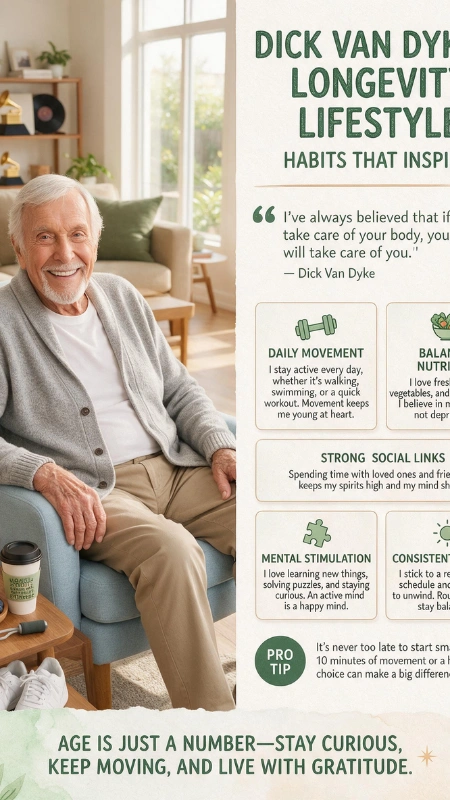
If you want more energy, sharper thinking, and a body that supports you for decades to come, his example offers more than inspiration. It offers a blueprint.
Who Is Dick Van Dyke? A Living Example of Active Aging
Before diving into his habits, it helps to understand why his story matters.
Born on December 13, 1925, Dick Van Dyke built a legendary career in entertainment. You likely know him from:
- The Dick Van Dyke Show
- Mary Poppins
- Chitty Chitty Bang Bang
- Numerous television appearances and live performances well into his 90s
What makes him remarkable isn’t just that he’s lived a long life. It’s that he’s lived it vibrantly. While many people accept decline as inevitable, Van Dyke challenges that assumption every time he steps into the spotlight.
And when asked about his vitality, Dick Van Dyke credits his longevity to a healthy lifestyle built on movement, moderation, joy, and purpose.
So how can you apply those same principles?
Dick Van Dyke Credits His Longevity to a Healthy Lifestyle: The Core Pillars
If you strip away the headlines, his approach comes down to four foundational pillars:
- Consistent physical activity
- Positive mindset
- Balanced eating habits
- A strong sense of purpose
Let’s break these down so you can put them into practice.
1. Move Your Body—Every Single Week
One of the most consistent themes in interviews is his commitment to exercise. Even in his 90s, he reportedly works out several times per week.
Why Movement Matters More Than You Think
As you age, your body naturally loses muscle mass, flexibility, and bone density. Without resistance training and mobility work, that decline accelerates.
Research from the CDC and Harvard Health confirms:
- Strength training preserves muscle and independence
- Regular activity lowers heart disease risk
- Exercise reduces fall risk by improving balance
- Movement supports cognitive function
Van Dyke’s routine typically includes:
- Light weight training
- Stretching exercises
- Core work
- Dancing for cardio
What This Means for You
You don’t need to train like an athlete. But you do need consistency.
Here’s a practical weekly structure you can follow:
- 3 days per week: Light strength training (30 minutes)
- 2–3 days per week: Walking or low-impact cardio
- Daily: 5–10 minutes of stretching
If you’re over 50, strength training becomes non-negotiable. Muscle equals independence.
And independence equals freedom.
2. Protect Your Mindset Like Your Life Depends on It (Because It Does)
Physical health is only half the equation. Dick Van Dyke credits his longevity to a healthy lifestyle that includes maintaining a joyful outlook.
He laughs often. He surrounds himself with energetic people. He continues working. He stays curious.
The Science Behind Optimism and Longevity
Studies from Harvard’s T.H. Chan School of Public Health have shown that optimistic individuals may live significantly longer than pessimistic counterparts.
Positive thinking is linked to:
- Lower stress hormone levels
- Reduced inflammation
- Better heart health
- Improved resilience
How You Can Build Mental Longevity
You can’t eliminate stress entirely. But you can change how you respond to it.
Start with these simple shifts:
- Spend time with people who energize you
- Limit exposure to constant negative news
- Keep learning something new
- Laugh daily—even if you have to watch old sitcoms
Aging isn’t just biological. It’s psychological.
If you believe you’re declining, you’ll act like it.
If you believe you’re still capable, you’ll behave accordingly.
3. Balanced Eating: No Extremes, No Fads
You won’t find Dick Van Dyke promoting restrictive crash diets. Instead, he practices moderation and balanced eating.
That’s good news for you.
Because sustainability beats intensity every time.
What a Longevity-Focused Plate Looks Like
Here’s a sample daily meal structure inspired by healthy aging principles.
Breakfast: Protein to Start Strong
| Ingredient | Quantity | Why It Matters |
|---|---|---|
| Eggs | 2 | Supports muscle repair |
| Spinach | 1 cup | Antioxidants for cellular health |
| Whole-grain toast | 1 slice | Fiber for digestion |
| Fresh berries | ½ cup | Reduces inflammation |
Protein in the morning helps preserve muscle mass and stabilize blood sugar—two major factors in aging well.
Lunch: Omega-3 and Fiber Boost
| Ingredient | Quantity | Why It Matters |
|---|---|---|
| Grilled salmon | 4 oz | Brain-supporting omega-3s |
| Quinoa | ½ cup | Complete plant protein |
| Mixed greens | 1 cup | Micronutrient density |
| Olive oil | 1 tbsp | Heart-healthy fats |
Healthy fats support cognitive function, which becomes increasingly important as you age.
Dinner: Light, Simple, Satisfying
| Ingredient | Quantity | Why It Matters |
|---|---|---|
| Grilled chicken | 4 oz | Lean protein |
| Steamed broccoli | 1 cup | Cancer-protective compounds |
| Sweet potato | 1 small | Stable energy source |
| Herbal tea | 1 cup | Hydration and relaxation |
The Real Lesson
You don’t need exotic superfoods.
Focus on:
- Lean protein
- Vegetables
- Whole grains
- Healthy fats
- Proper hydration
Avoid overeating. Eat until satisfied, not stuffed.
Longevity is often about what you don’t overdo.
4. Never Retire From Life
Here’s where things get powerful.
Dick Van Dyke continues performing, singing, and appearing publicly even in his later years. That sense of purpose may be one of the strongest longevity drivers of all.
Why Purpose Extends Lifespan
Research from the National Institute on Aging suggests that having a sense of purpose is linked to:
- Lower mortality risk
- Reduced risk of Alzheimer’s disease
- Improved emotional well-being
- Stronger social engagement
When you stop striving, you start declining.
Ask Yourself:
- What excites you?
- What skill have you neglected?
- Who benefits from your experience?
Purpose doesn’t have to mean global fame.
It could be:
- Mentoring someone younger
- Volunteering
- Learning an instrument
- Starting a small project
- Teaching what you know
The key is engagement.
5. Social Connection: The Overlooked Longevity Factor
One striking aspect of Van Dyke’s life is how socially connected he remains.
He collaborates. He performs. He interacts.
And that matters.
Studies from “Blue Zones” research show that strong social ties are one of the most consistent predictors of long life.
Isolation increases:
- Depression risk
- Heart disease
- Cognitive decline
If you want to follow the example of someone who credits his longevity to a healthy lifestyle, strengthen your social circle.
Schedule regular gatherings.
Call friends.
Join a group aligned with your interests.
You’re not meant to age alone.
6. Seven Habits You Can Start Today
If you’re wondering where to begin, here’s a simplified action plan inspired by Dick Van Dyke’s longevity habits:
- Strength train three times per week
- Walk daily
- Eat protein with every meal
- Limit processed foods
- Stay socially active
- Keep learning new skills
- Cultivate humor and optimism
Start with one. Then add another.
Progress compounds.
Frequently Asked Questions
How does Dick Van Dyke credit his longevity to a healthy lifestyle?
He attributes his long, active life to regular exercise, maintaining a positive attitude, staying socially engaged, and practicing moderation in his diet. His approach emphasizes consistency rather than extremes.
What type of exercise supports Dick Van Dyke’s longevity?
Strength training, stretching, and dancing are key components. Resistance exercises help preserve muscle mass, while flexibility work supports mobility and balance.
Does diet really impact longevity?
Yes. Research consistently shows that diets rich in lean proteins, vegetables, whole grains, and healthy fats reduce chronic disease risk and support cognitive health as you age.
Can you improve longevity even if you start later in life?
Absolutely. Studies indicate that adopting healthy habits—even in your 60s or 70s—can significantly improve lifespan and quality of life.
What His Example Means for You
It’s easy to admire someone like Dick Van Dyke and assume he’s genetically gifted.
Maybe he is.
But genetics load the gun. Lifestyle pulls the trigger.
If Dick Van Dyke credits his longevity to a healthy lifestyle, that’s encouraging. Because lifestyle is within your control.
You control:
- Whether you move today
- What you eat tonight
- Who you spend time with
- What thoughts you reinforce
- Whether you pursue purpose
Aging is inevitable. Decline is not entirely so.
Your Next Step: Don’t Just Read—Act
You don’t need to overhaul your life overnight.
Start small:
- Schedule your first strength workout this week
- Add vegetables to your next meal
- Call someone you haven’t spoken to in months
- Choose one goal that excites you
Then commit to consistency.
Longevity isn’t built in a year. It’s built in decades of daily decisions.
If this article inspired you, share it with someone who needs motivation to take better care of their health. Start the conversation. Encourage accountability.
Because one day, someone might look at you and ask:
“What’s your secret?”
And you’ll be able to say—with confidence—that you chose a healthy lifestyle long before you needed it.