
It’s 7:42 p.m. The dinner dishes are still soaking. The dog is doing that hopeful stare by the door. And your child is lying face-down on an unfinished worksheet like it personally insulted them.
You’ve asked three times. You’ve bargained twice. Now you’re using The Voice — the one you swore you’d never use.
Table of Contents
And underneath all of it sits the thought nobody says out loud at pickup: Am I messing this up?
Here’s what I want you to know before you read another word. Your child isn’t lazy, and you haven’t failed. Nobody is born knowing how to sit still, break a giant project into bite-sized pieces, or catch their own brain wandering off to Minecraft mid-sentence. Those are skills. Teachable, practiceable, learnable skills — like tying shoes or riding a bike, except no one hands you the instruction manual.
This guide is that manual. Figuring out how to teach kids healthy study habits has almost nothing to do with stricter rules or longer hours at the kitchen table. It’s about building small, repeatable systems that make focus the path of least resistance.
Get this right, and you’re not just rescuing tonight’s math sheet. You’re handing your kid a toolkit they’ll still be reaching for in college, at their first job, and at 2 a.m. when something genuinely matters.
What you’ll walk away with:
- A study space setup that actually cuts distraction
- A 7-step routine that ends the nightly standoff
- Age-by-age expectations for kids 5 to 14
- Three brain-fuel snack recipes with ingredient tables
- What to do when none of it seems to work
Why Healthy Study Habits Matter More Than Study Hours
Motivation is weather. Habits are climate.
On any given Tuesday, your child might feel wildly inspired to conquer fractions. On Wednesday, they won’t. If your homework system depends on how they feel, you’re rolling dice every single night. A routine removes the negotiation entirely — the work happens because it’s 4:10 p.m., not because anyone’s feeling scholarly.
There’s a deeper payoff too. Consistent study routines strengthen what researchers at Harvard’s Center on the Developing Child call executive function: working memory, mental flexibility, and self-control. They describe it as the brain’s air traffic control system. Kids aren’t born with those capacities fully installed — they’re built through practice and supportive structure.
And the benefits reach well past the report card. Children with predictable routines tend to show less homework-related anxiety, fewer arguments with parents, and more willingness to attempt hard things without falling apart.
Study Habits vs. Study Hours: What the Research Actually Shows
A landmark review by Dunlosky and colleagues, published in Psychological Science in the Public Interest, evaluated ten popular study techniques. The findings surprised a lot of people. Highlighting and rereading — the two methods almost every student defaults to — landed in the “low utility” category. Practice testing and spaced-out study sessions scored highest.
Translation: your child could spend two hours rereading a science chapter and retain less than a classmate who quizzed themselves for twenty minutes.
| Common Belief | What Learning Science Suggests | Better Approach |
|---|---|---|
| Longer sessions mean more learning | Attention collapses after a child’s focus window closes | Short, spaced sessions with real breaks |
| Rereading the chapter works | Creates a false sense of knowing | Self-quizzing and active recall |
| Cramming the night before is fine | Poor long-term retention | Review spread across several days |
| Multitasking saves time | Task-switching adds errors and time | One task, one screen, one timer |
| Kids should just push through | Fatigue wrecks accuracy and motivation | Movement, snack, reset |
Know Your Child’s Focus Window
Here’s a reality check that saves a lot of families a lot of yelling: a rough guideline used by many educators puts sustained attention at roughly two to five minutes per year of age — for tasks kids don’t enjoy.
That means your seven-year-old realistically has somewhere between fifteen and thirty-five minutes of genuine focus for a spelling packet. Not ninety. Asking for ninety isn’t discipline; it’s a setup for failure.
Kids with ADHD, dyslexia, autism, or anxiety often need even shorter blocks, more movement, and more external scaffolding. That’s not a deficiency to fix — it’s information to design around.
Realistic Expectations by Age
| Age / Grade | Focus Block | Nightly Homework | Habit to Build | Your Role |
|---|---|---|---|---|
| 5–6 (K–1) | 5–10 min | 10 min or read-aloud | Sitting down at the same time daily | Co-pilot beside them |
| 7–8 (2nd–3rd) | 10–20 min | 20–30 min | Packing their own bag, using a checklist | Nearby, prompting |
| 9–10 (4th–5th) | 20–30 min | 40–50 min | Planner use, breaking tasks into steps | Check in at start and finish |
| 11–12 (6th) | 25–35 min | 60 min | Self-quizzing, estimating task length | Coach, not manager |
| 13–14 (7th–8th) | 30–45 min | 70–80 min | Weekly planning, long-term projects | Consultant on request |
The National PTA and NEA have long recommended the “10-minute rule” — about ten minutes of homework per grade level per night. If your child consistently blows past that, the problem is rarely effort. Email the teacher.
How to Teach Kids Healthy Study Habits: The 7-Step System
To teach kids healthy study habits, set up a consistent study space and time, work in short focused blocks, use active recall instead of rereading, build in movement and snack breaks, teach planning tools, praise effort over outcomes, and review the week together.
Here’s how each piece works.
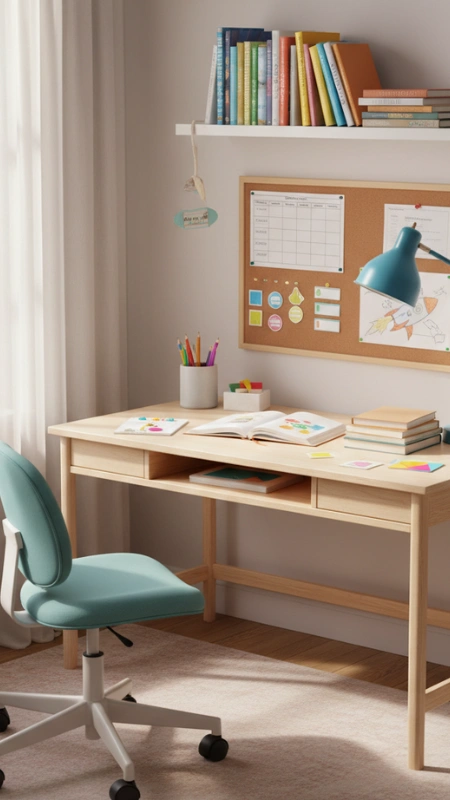
Step 1: Build a Dedicated, Distraction-Free Study Space
Your brain is shockingly suggestible about location. Study at the same desk every afternoon and, within a couple of weeks, sitting down there starts triggering “work mode” automatically. Study on the couch, the bed, and the kitchen island in rotation, and your child has to summon focus from scratch every single time.
Let your kid help design the space. Ownership drives buy-in — a child who picked the lamp and the pencil cup shows up differently than one who got assigned a corner.
| Zone | Must-Haves | Nice-to-Haves | Keep Out |
|---|---|---|---|
| Surface | Clear desk, chair with feet flat on floor | Adjustable height desk | Clutter, laundry, mail piles |
| Lighting | Bright, glare-free light | Warm task lamp | Harsh overhead-only lighting |
| Supplies | Pencils, eraser, paper, sharpener | Rolling cart or caddy | Toys, fidget overload |
| Tech | Timer or visible clock | Noise-cancelling headphones | Phone, tablet, TV, console |
| Visual cues | Weekly checklist, planner | Small whiteboard | Busy walls, visual noise |
One non-negotiable: the phone leaves the room. Not face-down. Not on silent. Gone. Research on attention consistently shows that mere proximity to a phone drains available cognitive capacity — the brain spends energy actively not checking it.
Step 2: Anchor Study Time to an Existing Routine
Habits form through a loop: cue, routine, reward. The easiest cue is an event that already happens daily.
“Homework after snack” beats “homework at 4:00” because snack always happens. “Homework after we walk the dog” works better than a clock alarm your kid learns to ignore.
Research by Lally and colleagues at University College London found that new habits took an average of 66 days to become automatic — with a range from 18 to 254 days depending on the person and the behavior. Read that range again. If week two feels like a slog, you’re not doing it wrong. You’re on schedule.
A sample elementary afternoon:
| Time | Activity | Why It Works |
|---|---|---|
| 3:30–4:00 | Snack and free movement | Refuels glucose, burns off energy |
| 4:00–4:10 | Launch pad: unpack bag, check planner | Builds the organization reflex |
| 4:10–4:35 | Focus block one — hardest subject | Peak energy meets hardest task |
| 4:35–4:45 | Movement break, no screens | Genuine attention reset |
| 4:45–5:05 | Focus block two — lighter work | Ends on a win |
| 5:05–5:10 | Pack tomorrow’s bag | Kills morning chaos |
Step 3: Work in Short Blocks with Real Breaks
Think of it as Pomodoro, scaled down for kids. Ten to twenty-five minutes on, five minutes off, adjusted to your child’s actual focus window rather than your hopes.
Get a visual timer — the kind with a red disc that shrinks. Young kids have almost no internal sense of duration, and watching time physically disappear does something a digital countdown never will.
Break rules matter enormously. A five-minute YouTube break doesn’t restore attention; it hijacks it. Movement does the job.
Eight breaks that actually work:
- Twenty jumping jacks
- Walk once around the house or block
- Drink a full glass of water
- Wall push-ups
- One song, dance however you want
- Pet the dog or cat
- Stretch and touch your toes
- Stare out a window at something far away
Step 4: Teach Methods That Actually Work
This is where most families leave the biggest gains on the table. Passive studying feels productive — the highlighter squeaks, the pages turn, the time passes. But recognition isn’t recall.
Swap passive for active:
| Passive Habit | Active Upgrade | Why It’s Better |
|---|---|---|
| Rereading notes | Cover the page, say it out loud | Forces retrieval, not recognition |
| Highlighting the textbook | Turn headings into questions | Builds a self-quiz automatically |
| Copying definitions | Flashcards, tested both directions | Practice testing rates high-utility |
| Studying the night before | Review today, in 2 days, in a week | Beats the forgetting curve |
The single best trick in this whole guide: Teach It Back. Have your child explain the concept out loud to you, a sibling, or a stuffed animal. The moment they stumble is the exact moment they’ve located the gap. Roediger and Karpicke’s research on the testing effect showed that retrieving information strengthens memory far more than restudying it — and explaining something out loud is retrieval with training wheels off.
Step 5: Build Organization with Planners and a Launch Pad
The rule: if it isn’t written down, it doesn’t exist.
Kids lose assignments not because they don’t care, but because working memory in a ten-year-old is genuinely limited. Externalize everything.
- Color-code by subject. Blue folder, blue notebook, blue tab. Math is always blue. No thinking required.
- Chunk big tasks. “Write a book report” is paralyzing. “Pick a book by Monday. Read half by Wednesday. Outline Thursday. Draft Friday.” is a plan.
- Create a launch pad. One basket or hook by the door holds backpack, shoes, water bottle, signed forms. Everything leaves from there and returns there.
- Run a Sunday reset. Ten minutes: empty the backpack, find the crumpled forms, look at the week ahead.
Step 6: Fuel the Brain
You can’t focus-hack your way out of exhaustion or an empty stomach.
- Sleep. The AAP and CDC recommend 9 to 12 hours for ages 6 to 12, and 8 to 10 hours for teens. Sleep is when the brain consolidates the day’s learning — a late-night cram session that costs two hours of sleep is usually a net loss.
- Movement. CDC guidelines call for 60 minutes of physical activity daily, and physical activity is consistently associated with better attention and academic performance.
- Hydration. Even mild dehydration has been linked to reduced attention in children. Keep a water bottle within arm’s reach.
- Food. Protein, fiber, and healthy fats stabilize energy. A sugar-heavy snack at 3:30 sets up a crash right when the hard thinking starts.
Which brings us to the part your kids will actually care about.
Three Brain-Fuel Study Snacks (With Ingredient Tables)
Focus Fuel Energy Bites
Prep: 10 min | Chill: 20 min | Makes: 16 bites
| Ingredient | Amount | Why It Helps |
|---|---|---|
| Rolled oats | 1 cup | Slow-release complex carbs |
| Peanut or sunflower butter | ½ cup | Protein and steady-burn fat |
| Honey or maple syrup | ⅓ cup | Light natural sweetness |
| Ground flaxseed | 2 tbsp | Omega-3 fatty acids |
| Mini dark chocolate chips | ¼ cup | Antioxidants and kid buy-in |
| Vanilla extract | ½ tsp | Flavor |
| Salt | 1 pinch | Balances sweetness |
Method: Stir everything together. Chill 20 minutes. Roll into balls. Keeps one week in the fridge. Use sunflower seed butter for nut-free classrooms.
Rainbow Study Plate
Prep: 5 min | Serves: 1
| Ingredient | Amount | Nutrient Focus |
|---|---|---|
| Baby carrots or pepper strips | ½ cup | Vitamin A, crunch wakes you up |
| Hummus | 2–3 tbsp | Plant protein and fiber |
| Blueberries or strawberries | ½ cup | Antioxidants |
| Cheese cubes or Greek yogurt | 1 oz / ½ cup | Protein and calcium |
| Whole-grain crackers | 5–6 | Sustained carbohydrates |
| Water with lemon | 1 glass | Hydration for attention |
Brain Boost Smoothie
Prep: 5 min | Serves: 2 kids
| Ingredient | Amount | Why It Helps |
|---|---|---|
| Frozen banana | 1 medium | Potassium, natural sweetness |
| Frozen blueberries | ½ cup | Antioxidants |
| Baby spinach | 1 large handful | Iron and folate, undetectable |
| Greek yogurt | ½ cup | Protein for staying power |
| Milk or oat milk | ¾ cup | Liquid base |
| Chia or flaxseed | 1 tbsp | Omega-3s |
| Nut butter (optional) | 1 tbsp | Extra staying power |
Blend 45 to 60 seconds. Serve before focus block one.
Timing cheat sheet: protein plus complex carbs right after school, water and fruit during breaks, small protein snacks on long nights. Skip energy drinks entirely — they aren’t recommended for children.
Step 7: Praise the Process, Not the Grade
Carol Dweck’s research at Stanford found something counterintuitive: praising kids for being smart made them less willing to attempt hard problems. If your identity is “smart,” a hard problem threatens it. Safer not to try.
Praise effort, strategy, and persistence instead.
| Instead of This | Try This |
|---|---|
| “You’re so smart!” | “You stuck with that even when it got frustrating.” |
| “An A! Amazing!” | “Your study plan worked — what part helped most?” |
| “That was easy for you.” | “That was tough, and you found a way through.” |
| “Don’t worry, math isn’t your thing.” | “You haven’t figured this one out yet.” |
Mistakes Parents Make (and What to Do Instead)
| The Mistake | Why It Backfires | Do This Instead |
|---|---|---|
| Hovering over every problem | Builds dependence, not skill | Sit nearby, answer after two attempts |
| Fixing their work | Teacher loses vital information | Let imperfect work go in |
| Using study time as punishment | Links learning to shame | Keep it neutral and routine |
| Starting homework at 8:30 p.m. | Fatigue destroys focus | Move the block earlier |
| Comparing to a sibling | Damages motivation badly | Compare to their own last week |
| Rewarding only top grades | Kills willingness to risk | Reward effort and honesty |
When Everything Is a Distraction
Distraction is an environmental design problem, not a character flaw. Fix the environment first.
Try a Distraction Parking Lot — a sticky note where your child jots down intrusive thoughts (“ask Mom about sleepover”) so the brain can release them and return to work.
On music: instrumental or ambient tracks help some kids, especially in loud homes. Lyrics almost always interfere with reading and writing. Test both for two weeks and let the evidence decide.
When to Get Extra Support
Watch for nightly meltdowns, homework taking two or three times the expected length, active avoidance, “I’m stupid” comments, or a sudden grade drop. Start with the teacher, then the school counselor or your pediatrician. Underlying ADHD, learning differences, vision or hearing issues, anxiety, and sleep problems are all common and all addressable.
This article is educational and isn’t a substitute for professional medical or psychological advice.
Your 30-Day Plan
| Week | Focus | Daily Action | Success Marker |
|---|---|---|---|
| 1 | Environment | Use the same study spot daily | Goes there unprompted 3×/week |
| 2 | Timing | Same start time, visual timer | Starts within 5 minutes |
| 3 | Method | Add one active-recall technique | Self-quizzes once per session |
| 4 | Independence | Step back, child leads the planner | Plans a full day solo |
Conclusion: You’re Not Raising a Student, You’re Raising a Learner
Come back to that kitchen table at 7:42 p.m.
The win here was never a perfect report card. It’s a kid who knows how to begin — who can look at something overwhelming, break off a corner, set a timer, and start. That skill outlasts every test they’ll ever take.
Some nights will still be hard. You’ll skip the routine. The timer will go missing. That’s not failure; that’s a Tuesday. Learning how to teach kids healthy study habits is less about discipline and more about designing a day where focus becomes the easy choice.
Pick one step from this guide — just one — and start tonight. Clear the desk. Set a start time. Move the phone.
Then tell me in the comments: which study habit has made the biggest difference in your house? Someone reading this needs your idea.
FAQs About How to Teach Kids Healthy Study Habits
At what age should I start teaching kids healthy study habits?
Start as early as kindergarten with ten-minute routines like reading together at the same time daily. At ages five to seven, the goal isn’t academic output — it’s the rhythm of sitting down, focusing briefly, and finishing something.
How long should my child study each day?
Use the 10-minute rule: roughly ten minutes per grade level per night. A third grader lands around 30 minutes, a seventh grader around 70. If it consistently takes far longer, contact the teacher.
How do I teach healthy study habits without fighting every night?
Make the routine the boss instead of you. A posted schedule, a visual timer, and a fixed start time do the enforcing. Kids argue with parents; they rarely argue with a chart and a clock.
What are the best study habits for kids with ADHD?
Shorter blocks of 5 to 15 minutes, frequent movement breaks, visual timers, one task visible at a time, body-doubling, and written checklists. Coordinate with your child’s teacher and care team.
What foods help kids focus while studying?
Pair protein, fiber, and healthy fats — Greek yogurt with berries, hummus and veggies, energy bites, or a spinach-banana smoothie. Add water. Skip high-sugar snacks and energy drinks.How long until a study habit sticks?
Research suggests about two months of near-daily repetition on average, with wide variation. Expect four to eight weeks before it feels automatic, and expect off days without scrapping the plan.