
Introduction: You Don’t Lack Discipline—You Lack a Repeatable System
You’ve probably told yourself, “I’ll start Monday.”
You felt motivated. Focused. Ready.
And for a few days, maybe even a few weeks, you followed through. Then life happened. Work deadlines piled up. Your energy dipped. Old routines quietly returned.
Table of Contents
Here’s the truth most people don’t realize: you don’t struggle because you’re lazy. You struggle because you haven’t learned how to build healthy habits that stick in a way that fits your real, everyday life.
Lasting habits aren’t built on bursts of motivation. They’re built on small, simple daily steps that feel almost too easy to fail. When you learn to build healthy habits that stick, you stop starting over—and start building momentum.
Let’s break down exactly how you can do that.
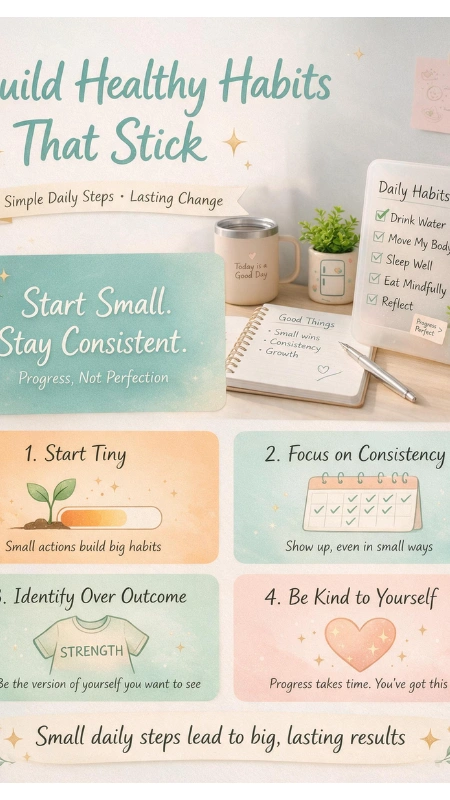
What Does It Really Mean to Build Healthy Habits That Stick?
Before you change your routine, you need to understand how habits actually work.
The Science of Habit Formation (In Plain English)
Every habit follows a simple neurological pattern:
- Cue – A trigger that tells your brain to act
- Routine – The behavior itself
- Reward – The benefit that reinforces it
This loop, described by researcher Charles Duhigg, explains why brushing your teeth feels automatic while exercising might not.
Research from University College London found that habits can take anywhere from 21 to 66 days to become automatic, depending on complexity and consistency. That means you don’t need perfection—you need repetition.
When you learn to build healthy habits that stick, you stop relying on mood and start relying on patterns.
Why Most Healthy Habits Fail
If you’ve struggled before, you’re not alone. Most attempts fail for predictable reasons:
- You start too big (“I’ll work out 6 days a week.”)
- You try to change everything at once
- You depend on motivation instead of structure
- You don’t attach habits to clear triggers
- You don’t track progress
The good news? Every one of these problems has a simple solution.
“Understanding behavioral psychology, as outlined by the American Psychological Association, shows that sustainable lifestyle changes rely on small, consistent steps rather than drastic overhauls.”
Start Small: The Power of Simple Daily Steps
If you want to build healthy habits that stick, think smaller than you think you should.
The 1% Better Approach
Improving by just 1% each day compounds over time. Small changes feel manageable. Manageable becomes repeatable. Repeatable becomes automatic.
Here are examples you can start today:
- Walk for 5 minutes after lunch
- Drink one extra glass of water
- Add one serving of vegetables to dinner
- Stretch for 2 minutes before bed
- Write one sentence in a journal
It sounds almost too simple. That’s the point.
Big goals create resistance. Small actions create consistency.
Habit Stacking: The Shortcut to Consistency
One of the easiest ways to learn to build healthy habits that stick is by attaching them to something you already do.
Use this formula:
After I an existing habit, I will a new habit.
Examples:
- After I brush my teeth, I will floss for 60 seconds.
- After I pour my morning coffee, I will drink a full glass of water.
- After I finish dinner, I will walk for 10 minutes.
You’re not adding something unfamiliar. You’re layering onto something stable.
Create a Healthy Morning Routine That Feels Effortless
Your morning shapes your day. Not because it needs to be perfect—but because it sets direction.
Why Mornings Matter
In the early hours:
- Your mental energy is higher
- Distractions are lower
- Decision fatigue hasn’t set in
You don’t need a 2-hour ritual. You need 15 focused minutes.
A Simple 15-Minute Morning Reset
Try this:
- 5 minutes of stretching
- Hydration (one full glass of water)
- 5 minutes of deep breathing or quiet reflection
That’s it. No pressure. No overwhelm.
If you want to add nutrition, start with something balanced and simple.
Energy-Boosting Overnight Oats Recipe
This quick breakfast supports your goal to build healthy habits that stick because it removes decision-making in the morning.
Ingredients
| Ingredient | Quantity | Why It Helps You |
|---|---|---|
| Rolled oats | ½ cup | Steady energy from fiber |
| Chia seeds | 1 tbsp | Omega-3s for heart health |
| Almond milk | 1 cup | Light, dairy-free option |
| Blueberries | ¼ cup | Antioxidant support |
| Honey | 1 tsp | Natural sweetness |
Preparation
- Mix all ingredients in a jar.
- Refrigerate over time.
- Grab and eat in the morning.
Simple. Predictable. Repeatable.
That’s how habits stick.
How to Build Healthy Eating Habits That Stick
You don’t need strict diets. You need sustainable structure.
Focus on Addition, Not Restriction
Instead of cutting everything you enjoy, start by adding:
- More vegetables
- More protein
- More water
- More whole foods
When you add nutrient-dense options, unhealthy choices often decrease naturally.
The Balanced Plate Formula
Use this visual guide at meals:
- ½ plate vegetables
- ¼ plate lean protein
- ¼ plate whole grains
- Healthy fats in moderation
This simple template removes confusion. You don’t need complicated calorie math.
Weekly Meal Prep Structure
Planning reduces decision fatigue.
| Meal Component | Examples | Prep Strategy |
|---|---|---|
| Protein | Chicken, tofu, lentils | Cook in bulk |
| Vegetables | Broccoli, carrots, spinach | Roast together |
| Whole Grains | Brown rice, quinoa | Batch cook |
| Healthy Fats | Avocado, olive oil | Add fresh daily |
Spending 60–90 minutes on Sunday can eliminate midweek stress.
When healthy food is ready, you’re far more likely to choose it.
Build Systems Instead of Relying on Motivation
Motivation is unreliable. Systems are steady.
Track Your Progress
Tracking works. According to research from the American Society of Training and Development, people who track goals are significantly more likely to achieve them.
You can:
- Use a habit tracking app
- Print a 30-day calendar
- Mark an “X” on paper daily
The visual progress creates momentum.
Design Your Environment for Success
Your surroundings shape your decisions more than willpower does.
Make good habits easier:
- Keep fruit visible
- Place a water bottle on your desk
- Lay out workout clothes the night before
Make unhealthy habits harder:
- Store junk food out of sight
- Delete food delivery apps
- Move your phone away before bed
When you adjust your environment, you reduce friction.
That’s how you learn to build healthy habits that stick long term.
Stay Consistent Even When Motivation Drops
There will be days when you don’t feel like it. That’s normal.
Consistency isn’t about feeling ready. It’s about acting anyway.
Use the “Never Miss Twice” Rule
Missing once is human. Missing twice builds a new negative pattern.
If you skip a workout Monday, move Tuesday.
If you eat poorly at lunch, reset at dinner.
Avoid the spiral. Reset quickly.
Shift to Identity-Based Habits
Instead of saying:
- “I’m trying to eat healthy.”
Say:
- “I am someone who takes care of my body.”
Instead of:
- “I need to exercise.”
Say:
- “I am someone who moves daily.”
When behavior supports identity, consistency becomes easier.
You don’t act differently—you act in alignment.
“Research supported by the National Institutes of Health emphasizes that creating repeatable daily routines is key to maintaining long-term physical and mental wellness.”
Healthy Habits for Mental Wellness
Physical health matters. Mental health determines sustainability.
5-Minute Mental Reset Practices
You can:
- Journal one page
- Take 5 slow breaths
- Step outside for fresh air
- Turn off notifications for 30 minutes
- Write one small win from your day
These small resets reduce stress and protect your energy.
Daily Gratitude Structure
| Time of Day | Action | Benefit |
|---|---|---|
| Morning | Write 3 things you appreciate | Improves mood |
| Afternoon | 5 deep breaths | Reduces stress |
| Evening | Reflect on one success | Builds confidence |
Mental clarity strengthens your ability to maintain other healthy routines.
Common Mistakes to Avoid
If you want to truly learn to build healthy habits that stick, watch for these traps:
- Doing too much at once
- Expecting immediate results
- Comparing your progress to others
- Ignoring small wins
- Quitting after one bad day
Habits are built through repetition, not perfection.
Frequently Asked Questions
How long does it take to learn to build healthy habits that stick?
It depends on the complexity of the habit. Research suggests 21 to 66 days on average. Simple habits like drinking water daily form faster than complex routines like full workout programs.
What is the easiest way to build healthy habits that stick?
Start extremely small. Attach the new habit to an existing routine and track it daily. Consistency beats intensity every time.
Can you build multiple healthy habits at once?
You can—but it’s more effective to focus on one or two habits until they feel automatic. Too many changes create overwhelm.
Why do healthy habits fail even when you try hard?
Because effort alone isn’t enough. Without structure, cues, tracking, and environmental design, motivation fades. Systems create sustainability.
Your Next Step: Start Small Today
You don’t need a life overhaul.
You need one small action repeated daily.
Choose one:
- Drink an extra glass of water
- Walk for 5 minutes after dinner
- Prep tomorrow’s breakfast tonight
- Write one sentence in a journal
Commit for 30 days. Track it. Protect it.
When you learn to build healthy habits that stick, you stop restarting your progress. You start building momentum that carries into every area of your life—your energy, your confidence, your health, your focus.
Your future self is shaped by what you repeat.
Start today.
If this guide helped you, choose one habit right now and take the first small step. Then share your commitment with someone who can hold you accountable. Small actions create lasting change—and yours begins now.
Disclaimer: This article is for general educational purposes and is not medical or professional advice. Please consult a qualified healthcare professional before making changes to your diet, exercise, or health routine. See our Medical Disclaimer.