
Picture this — your child sits at the kitchen table, books spread open, highlighter in hand, but their eyes are distant. Or maybe that student is you, sitting in a lecture hall, trying desperately to absorb information while your mind silently battles a storm no one can see. You’re not failing because you lack intelligence. You’re struggling because something far more foundational is being overlooked: your mental wellness.
Table of Contents
The truth that the education system is slowly — but urgently — waking up to is this: academic performance cannot be separated from emotional health. When students feel mentally unwell, their grades, their focus, their sense of belonging, and even their decision to stay in school all take a hit. And the numbers don’t lie.
If you’re a student, a parent, an educator, or a school administrator, this guide is your roadmap. Let’s break down everything you need to know about prioritizing student mental wellness — and why it needs to be your number one investment right now.
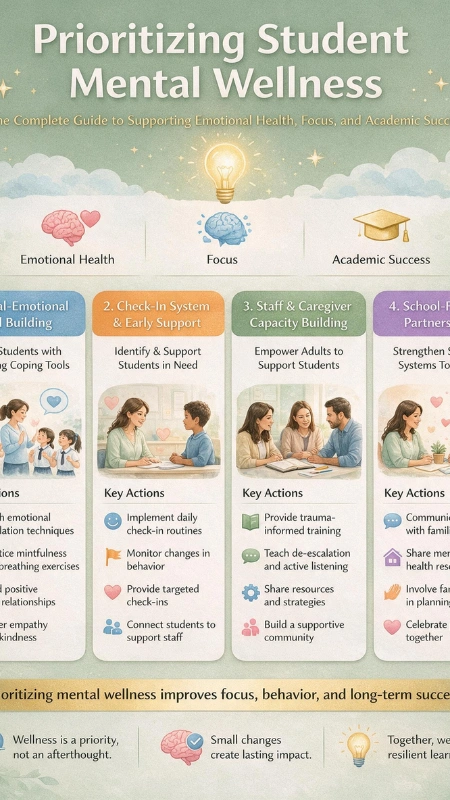
What Is Student Mental Wellness — And Why Does It Matter?
Going Beyond the Absence of Illness
Many people confuse mental wellness with the absence of a diagnosed disorder. But they’re not the same thing. A student can wake up every morning without a clinical diagnosis and still be emotionally depleted, disconnected, and struggling.
Research shows that good mental health is key to the success of all children and adolescents in school and life, and students’ mental health challenges encompass overall social, emotional, and behavioral health challenges such as feelings of anxiety, depression, stress, loneliness, or thoughts of self-harm.
Mental wellness is proactive, not reactive. It means building the emotional tools, social connections, and self-awareness that allow students to navigate pressure before it tips into crisis. Emotional well-being refers to managing and expressing emotions effectively, encompassing happiness, life satisfaction, and the ability to experience a range of emotions in a balanced manner, while psychological well-being involves self-acceptance, personal growth, purpose in life, environmental mastery, and autonomy.
The Alarming State of Student Mental Health Today
What the Latest Data Tells You
Before you can solve a problem, you need to see its full size. And when it comes to student mental wellness, the picture is both sobering and — in some ways — cautiously hopeful.
For the third year in a row, college students are reporting lower rates of depressive symptoms, anxiety symptoms, and suicidal thoughts. The 2024–2025 Healthy Minds Study, based on responses from more than 84,000 students across 135 colleges and universities, shows severe depression symptoms have dropped to 18% — down from 23% in 2022, and suicidal ideation has fallen to 11%, down from 15% in 2022.
That progress is real and worth acknowledging. But here’s what else is true:
Loneliness among students reporting high levels decreased from 58% in 2022 to 52% in 2025. However, reported levels of “flourishing” — psychological well-being including self-esteem, purpose, and optimism — dropped to 36% after reaching 38% in 2024.
In simpler terms: fewer students are hitting rock bottom, but fewer are truly thriving either.
Nearly two in five students (38 percent) indicated that they had positive mental health in 2023–24, compared with over half of students (51 percent) in 2013–14. That’s a 13-point drop in just a decade — a trajectory that should be impossible to ignore.
A May report from the U.S. Government Accountability Office found the number of postsecondary students with depression increased 226 percent from 2004 to 2020.
Absenteeism: The Hidden Cost
Poor mental health doesn’t just live inside a student’s head — it shows up in empty chairs and missed deadlines. More than one in four students in the 2022–2023 academic year missed at least 10% of the school year due to chronic absenteeism tied to mental health issues.
How Prioritizing Student Mental Wellness Directly Affects Academic Performance
The Direct Academic Toll
If you’ve ever tried to solve a math problem mid-panic attack, you already know the answer. But the research confirms it clearly:
Two in five students say their mental health is impacting their ability to focus, learn, and perform academically “a great deal,” and one in 10 students rate their mental health as “poor.”
A Virginia Commonwealth University study of nearly 10,000 college students reveals that behavioral and emotional health factors like depressive symptoms, antisocial behaviors, exposure to stressful events, and substance use increase a student’s risk of dropping out of college.
Depression is associated with lower GPA and higher drop-out risk among college and university students, and recent studies show that 75% of students have considered leaving over the past six months due to emotional stress.
That’s not a small number. That’s three out of every four students silently weighing whether staying enrolled is even worth it.
What Happens in the Brain
When a student is chronically stressed or anxious, the body floods the system with cortisol — a stress hormone that, over time, impairs memory, narrows thinking, and makes complex reasoning feel almost impossible. Students’ mental health in the context of emotional learning is essential to their academic and personal development. Emotional learning affects students’ emotional intelligence, social support, psychological capital, and educational environment — and emotions significantly impact learning, academic achievement, and overall well-being.
The Flip Side: What Good Mental Wellness Unlocks
When mental wellness is prioritized and protected, the academic results speak for themselves. Strong evidence of mental health can lead to proactive outcomes for students, including student success, engagement, and a sense of belonging.
Academic stress is a risk factor for students dropping out of college, and as students feel less stressed about their academics, they become more likely to persist in higher education.
The Role of Emotional Health in Student Success
Why Emotional Intelligence Changes Everything
You might think academic success is purely about discipline and study habits. But science keeps pointing to something deeper. Emotional learning impacts student outcomes at the nexus of behavior, well-being, cognitive engagement, and psychological resilience. Cognitive emotion management improves neuroplasticity, emotional intelligence, and behavior, while producing positive emotions and self-esteem.
Five Core Emotional Skills Every Student Needs
When you build these skills intentionally, your entire academic experience shifts:
- Self-awareness — Recognizing when you’re overwhelmed before it derails your performance
- Emotional regulation — Pausing before reacting to stressors, exam pressure, or social conflict
- Empathy — Understanding others’ experiences to build genuine, supportive friendships
- Resilience — Bouncing back from failure without catastrophizing your entire future
- Intrinsic motivation — Setting personal goals driven by meaning, not just external grades
Schools that increase their use of social-emotional learning and restorative practices show significant decreases in student depression, anxiety, and suicidal ideation, as well as improvements in attendance and achievement.
The Power of Belonging
One of the most underrated factors in student mental wellness is the simple feeling of belonging somewhere. One in five students reported feelings of loneliness. Despite the rise of technology, AI, and constant connection through social media, many students are still feeling lonely, and students report that they feel as if they do not belong — a growing concern and focus of attention on campuses.
When you feel connected — to classmates, to faculty, to a campus community — you’re more likely to stay, engage, and succeed.
Key Factors That Are Quietly Threatening Student Mental Wellness
Academic Pressure and the Perfectionism Trap
The pressure to perform perfectly is one of the most toxic dynamics in education today. Students report experiencing negative emotions while studying, like anxiety (41 percent), boredom (39 percent), and frustration (37 percent), more than positive ones like confidence (34 percent) and satisfaction (33 percent).
When anxiety drives your studying more than curiosity does, you’re operating in survival mode — and survival mode is the enemy of deep learning.
Social Media and Digital Overload
Seventy-two percent of students report feeling overwhelmed by constant connectivity through texts and social media, while nearly half have mixed feelings about technology’s impact on their relationships.
The comparison culture baked into every scroll session quietly erodes self-worth and amplifies anxiety. If you spend hours watching carefully curated highlight reels of other people’s successes, your brain starts treating that as the baseline — and you as falling short.
Loneliness in a Hyper-Connected World
This is one of the most counterintuitive crises of modern student life. A February 2024 survey by TimelyCare and Active Minds found that nearly two-thirds of currently enrolled college students reported experiencing frequent loneliness.
You can have a thousand followers and still feel completely alone in a lecture hall.
Proven Strategies for Prioritizing Student Mental Wellness
1. Practice Daily Mindfulness
Mindfulness isn’t about sitting cross-legged and thinking about nothing. It’s about training your mind to be present rather than caught in anxious spirals about the future or guilt about the past. Even five minutes per day of intentional breathing or body awareness can create measurable shifts in how you handle academic stress.
Try this today:
- Box breathing before an exam: inhale 4 counts, hold 4, exhale 4, hold 4
- A 10-minute guided meditation using apps like Headspace or Calm
- A short journaling session at night to process the day’s emotional weight
2. Move Your Body Consistently
Physical movement is one of the most research-backed tools for improving student mental wellness. Exercise releases feel-good neurochemicals — including dopamine and serotonin — that directly combat depression and anxiety. You don’t need a gym membership. A 20-minute walk between classes, a yoga video in your dorm room, or a weekly pick-up basketball game can meaningfully shift your emotional baseline.
3. Build Real, Meaningful Connections
83% of new students expect to use or are open to using campus mental health services — which tells you that the generation entering higher education right now understands the stakes. But professional support alone isn’t enough. You also need people — genuine friendships, mentors, study partners who see you.
Open communication, peer support systems, and accessible counseling services help normalize mental health discussions.
Join a club. Show up to office hours. Say yes to the study group. Real connection is medicine.
4. Get Professional Help — Without the Stigma
One of the most damaging myths in student culture is that reaching out for help is a sign of weakness. It is the opposite. Many schools offer counseling services and resources tailored to support students’ mental well-being. Encouraging students to utilize these resources provides an added layer of support. By leveraging these services, students access professional help and guidance that complements their academic experience.
What Schools, Parents, and Communities Can Do Right Now
Schools: Build It Into the Structure
Mental wellness cannot be an afterthought tucked into a school counselor’s packed schedule. Schools support student mental health by training educators to recognize early warning signs and fostering inclusive environments. Open communication, peer support systems, and accessible counseling services help normalize mental health discussions. Schools also integrate social-emotional learning into curricula and provide stress-management resources, equipping students with lifelong coping skills.
Prioritizing mental well-being improves academic engagement, attendance, and long-term resilience.
Parents: Create a Home That Feels Safe Enough to Be Honest
When parents actively participate in school-based mental health programs, student outcomes improve by 20%. Increased parental involvement leads to better emotional regulation, enhanced academic performance, and overall improved well-being for students. Schools that engage parents in mental health initiatives create a stronger support system, allowing students to thrive both emotionally and academically.
Your role isn’t to have all the answers. It’s to make your child feel safe enough to bring you the questions.
Communities: Normalize the Conversation
As institutions use these findings to shape mental health strategies, the data continues to inform efforts to create supportive campus environments that benefit students, faculty, staff, and the broader academic community.
Mental wellness is not a private battle — it’s a community responsibility.
Brain-Boosting Nutrition for Student Mental Wellness
What you eat directly shapes how you think, feel, and focus. The gut-brain axis is real — and it means your breakfast choices affect your classroom performance more than you might expect.
| Nutrient | Best Food Sources | Mental Wellness Benefit |
|---|---|---|
| Omega-3 Fatty Acids | Salmon, walnuts, flaxseeds | Reduces depression, boosts memory |
| Magnesium | Dark chocolate, spinach, almonds | Lowers anxiety, promotes sleep |
| Vitamin D | Eggs, fortified milk, sunlight | Combats seasonal depression |
| B Vitamins (B6, B12) | Whole grains, eggs, leafy greens | Supports serotonin production |
| Antioxidants | Blueberries, green tea, turmeric | Reduces brain inflammation |
| Probiotics | Yogurt, kefir, kimchi | Strengthens the gut-brain connection |
🥣 Quick “Focus Fuel” Overnight Oats — For Busy Students
| Ingredient | Quantity | Benefit |
|---|---|---|
| Rolled oats | ½ cup | Slow-release energy |
| Chia seeds | 1 tbsp | Omega-3s for brain health |
| Blueberries | ¼ cup | Antioxidants, reduces stress |
| Almond butter | 1 tbsp | Magnesium and healthy fats |
| Banana (sliced) | ½ | Tryptophan — serotonin precursor |
| Almond milk | ¾ cup | Vitamin D and calcium |
| Honey | 1 tsp | Natural energy boost |
| Cinnamon | ¼ tsp | Blood sugar regulation |
Instructions: Mix oats, chia seeds, and almond milk in a jar. Stir in almond butter and honey. Top with blueberries and banana. Refrigerate overnight. Grab and go — your brain will be ready before you finish lacing your shoes.
Your Daily Student Mental Wellness Checklist
Use this every morning as your personal wellness compass:
- ✅ 7–9 hours of sleep — non-negotiable for memory consolidation
- ✅ Brain-nourishing breakfast — never skip it
- ✅ 5–10 minutes of mindfulness — meditation, journaling, or breathing
- ✅ 20–30 minutes of movement — walk, stretch, dance, lift
- ✅ One meaningful social connection — a real conversation, not a like on Instagram
- ✅ Hydration — at least 8 glasses of water daily
- ✅ Tech-free wind-down — 60 minutes before bed, screens off
- ✅ One moment of gratitude — even on your worst days
FAQ: Prioritizing Student Mental Wellness
Q1: What does prioritizing student mental wellness actually look like in practice?
Prioritizing student mental wellness means building systems, habits, and environments that support students’ emotional health, self-regulation, and sense of purpose before a crisis occurs. It includes daily mindfulness practices, nutritional support, access to campus counseling, and a school culture that treats emotional wellbeing as a core educational outcome.
Q2: How does mental wellness affect a student’s academic grades?
Two in five students say their mental health is impacting their ability to focus, learn, and perform academically “a great deal.” When mental wellness is protected, cognitive performance, motivation, and academic persistence all improve significantly.
Q3: At what age should prioritizing student mental wellness begin?
As early as possible. The rates of young people experiencing persistent sadness or hopelessness have been on the rise since 2013. In 2023, the Centers for Disease Control and Prevention reported that 40% of high school students experienced persistent feelings of sadness or hopelessness, roughly one third experienced poor mental health, and 20% reported that they had seriously considered suicide. Prevention must begin well before the crisis peaks.
Q4: Can social media really affect student mental wellness that much?
Absolutely. Seventy-two percent of students report feeling overwhelmed by constant connectivity through texts and social media. Intentional, limited, and purposeful tech use is one of the most impactful wellness habits a student can develop.
Q5: What can parents do at home to support student mental wellness?
Create an open, judgment-free space for honest conversations. Monitor for behavioral changes — withdrawal, sleep disruption, appetite changes. Model healthy coping. And don’t wait for things to spiral before seeking professional support. When parents actively participate in school-based mental health programs, student outcomes improve by 20%.
Q6: Are things getting better for students’ mental health?
For the third year in a row, college students are reporting lower rates of depressive symptoms, anxiety symptoms, and suicidal thoughts — which is genuinely encouraging. But the work of prioritizing student mental wellness is far from finished.
Conclusion: Make Mental Wellness the Foundation, Not the Footnote
The evidence is no longer subtle. Research shows that good mental health is key to the success of all children and adolescents in school and life. Yet for far too long, schools have treated mental wellness as something to address after academic performance slips — rather than as the very condition that makes academic performance possible.
Whether you’re a student carrying invisible weight into every class, a parent watching your child slowly withdraw, or an educator trying to reach a student who’s clearly somewhere else — the answer starts the same way: by putting mental wellness first.
The data shows progress is possible. Districts and schools can find success in promoting student well-being by using data to establish actionable goals, providing a multi-tiered system of support, and taking innovative approaches to funding and resourcing.
Small, consistent steps — a mindful morning, a nourishing breakfast, one honest conversation, one day off the doom-scroll — are not small at all. They are the architecture of a student who doesn’t just survive their education but genuinely thrives through it.
💡 Ready to take the first step? Share this article with a student, parent, or educator in your life who needs to read it. Leave a comment below telling us — what’s one mental wellness habit you’re committing to this week? Your honesty might be exactly what someone else needs to hear.
Sources: Healthy Minds Study 2024–2025 (University of Michigan School of Public Health); Inside Higher Ed Student Voice Survey 2024–2025; American Council on Education Mental Health Stats Report 2025; Learning Policy Institute Fact Sheet 2025; Schools That Lead Mental Health Statistics; TimelyCare & Active Minds Survey 2024; Mantra Health; Scientific Reports, Nature 2025.