
You found it at the back of the shed, behind the bag of potting soil that hardened into a brick sometime around 2019. A spade with a wooden handle worn smooth and dark, the grain polished by somebody else’s hands. Maybe your dad’s. Maybe it came with the house.
The blade still bites. The handle still holds. And you are never, ever going to use it again.
Table of Contents
That’s the strange little standoff a lot of us end up in. Tossing a working tool in the dumpster feels wrong, like throwing out a set of instructions somebody spent forty years writing. But keeping it means you’ll keep shuffling it sideways every time you need to get to the lawn mower.
There’s a third option, and it’s better than both. Somewhere within a few miles of you, a first-year gardener, a third-grade classroom, or a neighborhood food plot is short exactly one good spade. Here’s exactly where to donate garden tools so they land in working hands instead of a landfill.
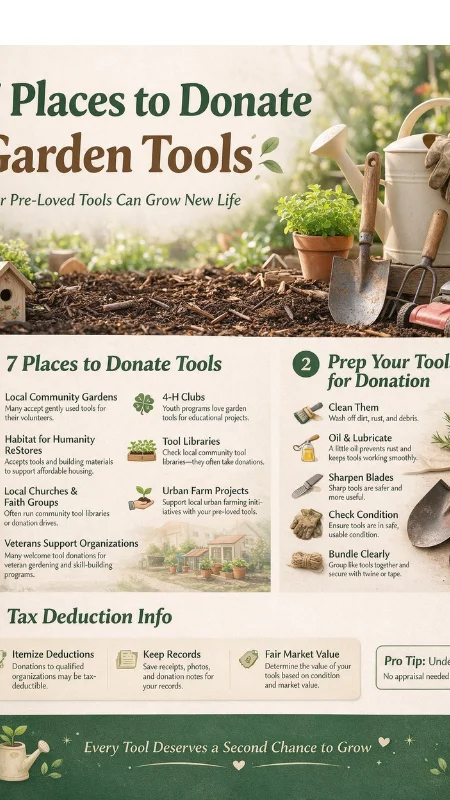
Why Donating Garden Tools Matters More Than You Think
A cheap trowel bends in a season. A forged steel spade with an ash handle can outlive two or three owners — which means the tool in your shed isn’t at the end of its life. It’s roughly halfway through.
That matters for a few practical reasons:
- Good tools are expensive. A decent spade, a solid pair of bypass pruners, or a well-balanced hoe will each run you $30 to $80 new. For a community garden outfitting twenty plots, that math gets painful fast.
- Tools are a real barrier to entry. Plenty of people want to grow food and simply can’t front the startup cost. Groups like the American Community Gardening Association consistently list basic equipment among the things new gardens need most.
- Metal and wood belong in circulation, not in the ground. The EPA’s data on durable goods in municipal solid waste tells a pretty grim story about how much perfectly repairable stuff gets buried. Garden tools are among the easiest items to keep out of that stream.
- Gardening does more than produce tomatoes. Community plots have measurable effects on food access and mental health. Your unused rake is a very small part of a very good system.
So the question isn’t whether to donate. It’s where — and how to make sure your donation actually gets used instead of quietly tossed by an overwhelmed volunteer.
Before You Donate: How to Prep Your Garden Tools
Here’s the part most people skip, and it’s the difference between a donation that gets shelved and one that gets refused.
Spend twenty minutes. Seriously, that’s all it takes.
- Knock off the soil and rust. A wire brush handles most of it. For heavier corrosion, soak the metal head in white vinegar overnight, then scrub.
- Sharpen the working edge. Run a mill file along spades, hoes, and loppers at the original bevel angle. A sharp tool reads as “cared for.” A dull one reads as “somebody’s junk.”
- Inspect the handle. Cracks and splinters are the number one reason tools get rejected. Sand rough spots and rub in boiled linseed oil — the wood drinks it up and looks twenty years younger.
- Oil the pivots. Pruners, loppers, and hose reels all seize up in storage. A few drops of machine oil and some working back and forth usually frees them.
- Drain fuel and oil from anything powered. Mowers, trimmers, tillers, chainsaws. Almost every organization requires this, and it’s a hard rule, not a suggestion.
- Bundle the small stuff. Tape sets together or bag your hand trowels. Loose items scatter, get separated, and end up in a miscellaneous bin nobody sorts.
- Photograph anything valuable. You’ll want this if you plan to claim a deduction.
What Condition Do Donation Centers Actually Require?
The rule of thumb is simple: if you wouldn’t hand it to a friend, don’t hand it to a charity. Donation centers pay to dispose of unusable items, so dropping off broken gear just shifts your problem onto a nonprofit’s budget.
That said, “broken” isn’t always a dealbreaker. Tool libraries and repair-focused groups often want fixable items — a snapped handle is a fifteen-minute job for someone with a workbench. Call first and ask.
What almost nobody accepts:
- Anything with fuel or oil still inside
- Power tools with missing safety guards or frayed cords
- Blades rusted through or pitted past sharpening
- Opened pesticide, herbicide, or fertilizer containers
- Gas cans, full or empty
Where to Donate Garden Tools: 7 Places That Accept Used Equipment
1. Habitat for Humanity ReStore
Best for: Almost anything, including powered equipment
ReStores are resale outlets that funnel proceeds straight into local home-building projects. They’re the closest thing to a one-stop answer for where to donate garden tools, because they’ll take the awkward stuff other places won’t.
What they typically accept: hand tools, lawn mowers, wheelbarrows, hoses, unopened fertilizer and soil, planters, patio furniture.
The bonus: many locations schedule free pickup if you’re donating a large load — worth knowing if you’re clearing out an entire shed or handling an estate.
How to find one: Use the store locator on habitat.org. Policies genuinely vary store to store, so make a quick phone call before you load the car.
2. Local Community Gardens
Best for: Tools you want to see used, not resold
This is direct-to-user donation with no middleman. Your spade goes from your shed to somebody’s plot, sometimes the same week.
What they need most: spades, rakes, hoes, watering cans, garden gloves, wheelbarrows, hoses, and stakes. Shared tool sheds take constant abuse, so replacements are always welcome.
How to find one: Check the ACGA garden directory, call your city’s parks department, or post in a neighborhood Facebook group. Your county extension office usually maintains a list too.
3. Tool Libraries and Lending Sheds
Best for: Quality tools, and anything that needs minor repair
Tool libraries work exactly like book libraries — members borrow a tiller for a weekend instead of buying one they’ll use twice. They’ve expanded rapidly across North America and the UK over the past decade.
The key advantage for you: most are volunteer-run and staffed by people who genuinely enjoy fixing things. That rusty pruner you’re on the fence about? They’ll restore it.
How to find one: Search “[your city] tool library” or browse the Local Tools directory online.
4. Schools, 4-H Clubs, and Youth Garden Programs
Best for: Hand tools, kid-sized equipment, pots, and seeds
School gardens run on donations and stubborn optimism. FFA chapters and 4-H clubs are in the same boat. If you’ve got lightweight trowels, small gloves, seed trays, or nursery pots, this is where they’ll do the most good.
The bonus: schools and registered youth programs will almost always issue a donation receipt.
How to find one: Contact the district facilities office, or email a specific school’s garden coordinator directly. Teachers respond fast to offers of free supplies.
5. Goodwill, Salvation Army, and Local Thrift Stores
Best for: Convenience and mixed-item volume
If you’re already carrying out bags of clothes and kitchenware, throwing the garden tools in the same trip makes obvious sense. Thrift stores have the widest drop-off coverage of any option on this list, and Salvation Army offers scheduled pickup across many regions.
One caveat: acceptance of gas-powered equipment swings wildly by location. Some stores take mowers happily; others won’t touch them.
6. Faith-Based Groups, Shelters, and Transitional Housing
Best for: Tools that support grounds upkeep or job training
Churches, synagogues, mosques, and temples maintain grounds, and many run food gardens that supply their own pantries. Meanwhile, shelters and reentry programs frequently use landscaping work as vocational training — which means mowers, trimmers, and edgers get put straight to work teaching a marketable skill.
How to find one: Call the office directly and ask for whoever handles grounds or facilities.
7. Freecycle, Buy Nothing, and Neighborhood Networks
Best for: Odd items, partial sets, and same-week pickup
Peer-to-peer giving skips the organization entirely. You post a photo, somebody down the street says “I’ve been looking for one of those,” and it’s gone by Saturday.
Where to post: Buy Nothing Project groups, Freecycle.org, Nextdoor, and the Craigslist free section.
The tradeoff: no tax receipt. But it’s easily the fastest route, and there’s something satisfying about knowing exactly which yard your tools ended up in.
Garden Tool Donation Comparison Chart
| Donation Spot | Accepts Power Equipment? | Pickup Available? | Tax Receipt? | Best For |
|---|---|---|---|---|
| Habitat ReStore | Usually yes | Often, for large loads | Yes | Mowers, tillers, bulk donations |
| Community Garden | Sometimes | Rarely | Sometimes | Hand tools, hoses, wheelbarrows |
| Tool Library | Yes | No | Varies | High-quality and repairable tools |
| School / 4-H Program | Rarely | No | Usually | Trowels, gloves, kid-sized tools |
| Goodwill / Thrift | Varies by store | Some locations | Yes | Mixed household and garden lots |
| Shelter / Faith Group | Sometimes | Occasionally | Usually | Mowers, trimmers, grounds tools |
| Buy Nothing / Freecycle | Yes | Recipient collects | No | Anything, fast, zero hassle |
Quick Match: Which Tool Goes Where?
| If You Have… | Send It To… |
|---|---|
| A working gas mower | Habitat ReStore or a shelter with grounds |
| A rusty but solid spade | Tool library — they’ll restore it |
| 20 plastic nursery pots | Community garden or local nursery |
| Kid-sized trowels and gloves | School garden or 4-H club |
| Snapped-handle loppers | Repair café or scrap metal recycling |
| A full shed clear-out | ReStore pickup or Buy Nothing group |
What to Do With Broken or Unusable Garden Tools
Not everything deserves a second home. Here’s where the rest goes.
Scrap metal recycling. Steel heads, aluminum frames, and copper hose fittings all carry scrap value. Most municipal transfer stations take them free, and some scrap yards will pay you a few dollars for a full load.
Repair cafés. These are volunteer fix-it events held in libraries and community centers, and they exist in thousands of towns worldwide. Bring the tool, bring coffee money, leave with something that works.
Replace the handle yourself. A replacement hickory handle costs around $12 and installs in under an hour. On a $70 tool, that’s an easy call.
Hazardous materials. Old pesticides, herbicides, and leftover fuel need to go to a household hazardous waste collection event — never to a donation bin, never down a drain, never in the curbside trash. Your county solid waste authority publishes the schedule.
Can You Claim a Tax Deduction for Donated Garden Tools?
Often, yes — if you follow the rules.
- The recipient has to be a registered 501(c)(3) organization. Buy Nothing groups and individual neighbors don’t qualify.
- You have to itemize your deductions rather than taking the standard deduction.
- You claim fair market value — what a thrift store would realistically charge for the item today, not what you paid in 2004.
- Get a written receipt. Always. Every time.
- Total non-cash donations above $500 require IRS Form 8283 with your return.
Goodwill and Salvation Army both publish valuation guides that give you defensible numbers for common items. Keep your photos and a simple itemized list alongside the receipt.
This is general information, not tax advice. Talk to a tax professional about your specific return.
How to Find Garden Tool Donation Spots Near You
- Search “garden tool donation near me” plus your city name — local results beat national directories.
- Call parks and recreation; they usually know every community garden in town.
- Contact your county extension office. Master Gardener programs take tools constantly.
- Post in a local gardening or Buy Nothing group and let people come to you.
- Ring the nearest ReStore about pickup if you’re clearing a whole shed at once.
Conclusion: Give Your Tools a Second Season
That spade with the worn handle isn’t finished. It’s just between jobs.
There are at least seven good answers to where to donate garden tools, and the right one depends entirely on what’s sitting in your shed right now. Power equipment leans toward ReStore. Hand tools belong in a community garden. Anything broken but fixable should go to a tool library that’ll love it back to life.
You don’t need to sort the whole shed this weekend. Pick one tool. Make one phone call. That’s genuinely the entire first step.
Then tell us how it went. Drop a comment with where you donated and what you gave away — local recommendations help other readers more than any directory can. And if you’ve got something you’re not ready to part with yet, read our guide on restoring a rusted garden tool in twenty minutes before you decide.
FAQ: Where to Donate Garden Tools
Where can I donate garden tools near me?
Start with Habitat for Humanity ReStore, your nearest community garden, a local tool library, or a thrift store like Goodwill. School garden programs and Buy Nothing groups are strong options too. Acceptance policies differ by location, so always call ahead before loading up the car.
Do charities accept rusty or old garden tools?
Many will, provided the tool is structurally sound — surface rust cleans off easily with a wire brush and vinegar. Tool libraries and repair cafés actively welcome fixable items. Tools with rusted-through blades or cracked handles should go to scrap metal recycling instead.
Where can I donate a used lawn mower?
Habitat ReStore accepts mowers at most locations, as do many shelters, transitional housing programs, and faith-based groups that maintain grounds. Drain all fuel and oil first — this is a firm requirement nearly everywhere, and mowers arriving full are usually turned away.
Can I get a tax deduction when I donate garden tools?
Yes, if you donate to a registered 501(c)(3) and itemize your deductions. Claim fair market value, keep a written receipt, and file Form 8283 for total non-cash donations over $500. IRS Publication 526 covers the details.
What garden tools should I not donate?
Skip anything with a cracked or snapped handle, missing safety guards, frayed electrical cords, or blades rusted past sharpening. Never donate opened pesticides, herbicides, or fuel containers — those require household hazardous waste disposal.
Where can I donate garden tools if nothing local accepts them?
Try Buy Nothing, Freecycle, or Nextdoor, where neighbors claim items directly. If nobody takes them, bring metal tools to a scrap recycler — steel and aluminum heads have real value and stay out of the landfill.