
There’s something magical about unboxing your first Monstera. You picture those gorgeous, holey leaves cascading over a bookshelf — the kind you’ve double-tapped a hundred times on Instagram. But then reality hits. The leaves yellow. The stems droop. And suddenly, you’re Googling “why is my Monstera dying” at 2 a.m.
Table of Contents
Sound familiar? You’re not alone. Monstera plant care trips up nearly every beginner — not because it’s complicated, but because nobody lays it out simply enough. That changes right now. This guide walks you through every single step, from picking the right pot to troubleshooting brown spots. By the time you finish reading, you’ll feel like your Monstera is in very capable hands — yours.
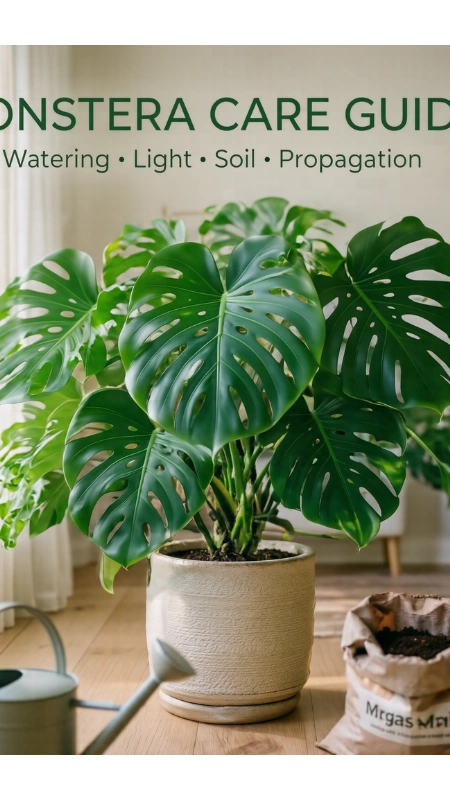
What Is a Monstera Plant? (And Why Everyone Loves It)
Before diving into the how-to, let’s talk about what makes this plant so wildly popular. The Monstera Deliciosa — nicknamed the “Swiss Cheese Plant” — hails from the tropical rainforests of Central America, stretching from southern Mexico down through Panama. In the wild, it climbs massive trees, reaching for sunlight beneath a thick canopy.
That climbing nature? It’s baked into the plant’s DNA, and it directly affects how you care for one at home.
A few popular varieties you’ll encounter:
- Monstera Deliciosa — the classic, large-leafed beauty
- Monstera Adansonii — smaller, with more delicate holes
- Monstera Thai Constellation — a rare, variegated stunner with cream-colored speckles
Quick Monstera Plant Profile
| Feature | Details |
|---|---|
| 🌱 Botanical Name | Monstera Deliciosa |
| 🌍 Origin | Central America |
| ☀️ Light Needs | Bright, indirect sunlight |
| 💧 Watering | Every 1–2 weeks |
| 🌡️ Ideal Temperature | 65°F – 85°F (18°C – 29°C) |
| 🌿 Humidity | 60%+ preferred |
| 🪴 Soil Type | Well-draining, peat-based mix |
| 📏 Mature Size | Up to 10 ft indoors |
| ⚠️ Toxicity | Toxic to cats & dogs |
Getting Started — What You’ll Need
You wouldn’t bake a cake without gathering your ingredients first, right? Same principle applies here. Before your Monstera even touches soil, round up these essentials:
| Item | Purpose | Best Pick |
|---|---|---|
| 🪴 Pot | Housing | Terracotta with drainage holes |
| 🌍 Soil | Root nutrition | Peat-based, chunky mix |
| 💧 Watering Can | Precision watering | Long-spout style |
| 🌱 Fertilizer | Growth fuel | Balanced liquid (20-20-20) |
| 🪵 Moss Pole | Climbing support | Sphagnum moss pole |
| ✂️ Pruning Shears | Trimming | Sharp, sterilized |
| 📊 Moisture Meter | Prevent overwatering | Probe-style |
When picking your plant at the nursery, look for deep green leaves with no brown patches, firm stems, and soil that isn’t waterlogged. Lift the pot — if roots snake out from the bottom, it probably needs repotting right away.
Light Requirements for Monstera Plant Care
Here’s where most beginners go wrong. They either blast their Monstera with harsh afternoon sun or tuck it into the darkest corner of the room. Neither works.
What Kind of Light Does Your Monstera Actually Need?
Think about where this plant grows in nature — underneath a thick tree canopy where sunlight filters through in soft, dappled patches. Your job is to recreate that. Place your Monstera near a north or east-facing window where it receives bright but indirect light. A sheer curtain over a south-facing window also does the trick beautifully.
How to Spot Lighting Problems
Too much light:
- Scorched brown patches on leaves
- Faded, washed-out green color
- Dry, crispy edges
Too little light:
- Long, leggy stems reaching desperately toward the window
- Tiny new leaves with zero fenestrations
- Painfully slow growth
🔄 Pro Tip: Rotate your pot a quarter turn every couple of weeks. This keeps growth even on all sides and prevents that awkward “leaning tower” look.
How to Water Your Monstera — The #1 Mistake Beginners Make
If monstera plant care had a villain, overwatering would wear the cape. More Monsteras die from too much love than neglect. Let’s fix that.
Your Watering Schedule
Stick your finger two inches into the soil. Dry? Water it. Still damp? Walk away and check again in a couple of days. Generally, this works out to every 1–2 weeks, but your home’s temperature, humidity, and season all shift the timing.
Overwatering vs. Underwatering — Know the Difference
| Sign | Overwatering 💦 | Underwatering 🏜️ |
|---|---|---|
| Leaves | Yellow, mushy | Brown, crispy edges |
| Soil | Soggy, won’t dry | Bone dry, shrinking from pot |
| Roots | Soft, black, smelly | Dry, brittle |
| Stems | Mushy, drooping | Wilted but still firm |
Golden Rules of Watering
- Always check moisture before adding water — every single time
- Use room-temperature water (cold water shocks tropical roots)
- Water slowly and thoroughly until liquid flows from the drainage holes
- Empty the saucer underneath — never let your plant sit in a puddle
- Switch to filtered water if your tap runs heavy with chlorine
Best Soil Mix for Monstera Plant Care
Your Monstera’s roots need two things simultaneously: moisture and oxygen. Standard potting soil holds too much water and suffocates the roots. You need something chunkier.
DIY Monstera Soil Recipe 🌱
| Ingredient | Amount | Why It’s There |
|---|---|---|
| 🟫 Peat-Based Potting Soil | 2 parts | Base layer, holds nutrients |
| 🪨 Perlite | 1 part | Boosts drainage, adds air pockets |
| 🌿 Orchid Bark | 1 part | Creates chunky texture for airflow |
| 🥥 Coco Coir | ½ part | Retains the right amount of moisture |
| 🪵 Horticultural Charcoal | ¼ part | Fights root rot and keeps soil fresh |
Toss everything into a large bucket, mix it up, and dampen it slightly before potting. Your Monstera’s roots will thank you.
Humidity & Temperature — Recreating the Tropics at Home
Humidity Sweet Spot
Your Monstera craves 60% humidity or higher. Most homes hover around 30–50%, which means you’ll likely need to bridge the gap. Here’s how:
- Humidifier — the most reliable method by far
- Pebble tray — fill a tray with pebbles and water, set the pot on top
- Group plants together — they create a little microclimate of shared moisture
- Misting — feels productive, but honestly, the effect fades in minutes
Temperature Boundaries
Keep your space between 65°F and 85°F. Monstera absolutely cannot handle frost or cold drafts, so pull it away from leaky windows in winter and keep it clear of air conditioning vents in summer.
Fertilizing — Give Your Monstera Fuel to Grow
During spring and summer, your Monstera enters its active growing phase and burns through nutrients fast. Feed it a balanced liquid fertilizer (20-20-20) diluted to half strength once a month.
| Season | Frequency | Strength |
|---|---|---|
| 🌸 Spring | Monthly | Half strength |
| ☀️ Summer | Monthly | Half strength |
| 🍂 Fall | Every 6–8 weeks | Quarter strength |
| ❄️ Winter | Skip entirely | — |
Watch for signs you’ve gone overboard — brown leaf tips, a white crusty buildup on the soil, or sudden yellowing of lower leaves. If that happens, flush the soil with plain water and hold off on feeding for a while.
Repotting — When Your Monstera Outgrows Its Home
Every 1–2 years, your Monstera will need a bigger pot. The clearest signal? Roots poking out from the drainage holes or circling the inside of the pot like a tangled highway.
Step-by-Step Repotting
- Pick a pot 2 inches wider than the current one — not bigger
- Mix your fresh soil (see the recipe above)
- Gently slide the plant out, supporting the base
- Shake loose the old soil and inspect roots — snip anything black or mushy
- Place in the new pot, fill around the sides with soil, and press gently
- Water thoroughly
- Hold off on fertilizer for at least 3–4 weeks — let the roots settle in
Pruning & Propagation — Shape It and Share It
Pruning Basics
Grab your sterilized shears and remove any yellow, brown, or damaged leaves at the stem base. If growth feels wild and leggy, trim back the longest vines to encourage a fuller, bushier shape.
How to Propagate Your Monstera
This is the fun part — making baby plants from your existing one.
- Find a healthy stem with at least one node (the little bump where roots sprout)
- Cut just below the node
- Drop the cutting into a jar of clean water or damp sphagnum moss
- Set it in bright, indirect light
- Swap the water every 3–5 days
- Watch for roots — they typically appear within 2–4 weeks
- Once roots hit 2–3 inches, transfer to soil
Common Monstera Plant Care Problems & Fixes
| Problem | Likely Cause | Fix |
|---|---|---|
| 🟡 Yellow leaves | Overwatering | Cut back on water, check drainage |
| 🟤 Brown tips | Low humidity | Add a humidifier or pebble tray |
| ⚫ Black stems | Root rot | Trim damaged roots, repot in fresh soil |
| 🕳️ No holes in leaves | Insufficient light | Move closer to a bright window |
| 🐛 Pests | Dry conditions | Treat with neem oil |
| 😞 Droopy leaves | Watering imbalance | Test soil moisture and adjust |
A Note for Pet Owners ⚠️🐾
Monstera contains calcium oxalate crystals, which are toxic to cats and dogs. If your pet chews on a leaf, watch for drooling, pawing at the mouth, or vomiting. Place your plant on a high shelf or hang it from the ceiling. If your furry friend is a persistent nibbler, you might want to explore pet-safe plant alternatives.
Conclusion — Your Monstera Journey Starts Right Now
Monstera plant care boils down to a handful of basics: the right light, smart watering habits, chunky soil, decent humidity, and a little fertilizer during the growing months. That’s really it. You don’t need a botany degree. You don’t need a green thumb passed down through generations. You just need to pay attention.
Every new leaf your Monstera unfurls is a quiet little high-five — proof that you’re doing something right. So bookmark this guide, check back whenever something looks off, and trust the process.
Now it’s your turn — drop a comment below and tell us: what’s the biggest challenge you’ve faced with your Monstera? Let’s troubleshoot it together. 💚🌿
FAQs About Monstera Plant Care
1. How often should you water a Monstera for proper monstera plant care?
Water every 1–2 weeks after checking that the top two inches of soil are dry. Consistency matters more than a rigid schedule.
2. Why are your Monstera’s leaves turning yellow?
Nine times out of ten, yellow leaves point to overwatering. Revisit your monstera plant care watering routine and make sure drainage is solid.
3. Does a Monstera need direct sunlight?
Absolutely not. Direct sun burns the leaves. Bright, indirect light is the sweet spot for healthy monstera plant care.
4. How do you get more fenestrations (holes) on your Monstera?
Give it more light, consistent water, and monthly feeding. With patient monstera plant care, mature leaves will develop those iconic splits naturally.
5. Is monstera plant care hard for beginners?
Not even close. Monstera is one of the most forgiving houseplants around. Follow this guide and you’ll handle it with ease.
6. Can you keep a Monstera outside?
Yes — in warm months above 65°F and in a shaded spot. Just remember to water more frequently when it’s outdoors.
7. How fast does a Monstera grow?
With solid monstera plant care, expect 1–2 feet of growth per year indoors, with a fresh leaf every 4–6 weeks in peak season.