
Resistance band leg workouts are a simple way to strengthen your legs and glutes at home without needing a gym full of equipment. With one resistance band and a little space, you can perform exercises that target your quadriceps, hamstrings, glutes, and hip muscles.
Whether you are new to strength training or looking for a convenient way to add variety to your routine, resistance bands can help you adjust the challenge to your fitness level. The key is choosing suitable exercises, using controlled movements, and progressing gradually.
Table of Contents
In this guide, you will learn how to choose a resistance band, perform six effective leg exercises, follow a beginner-friendly workout plan, and avoid common training mistakes.
Resistance Band Leg Workouts
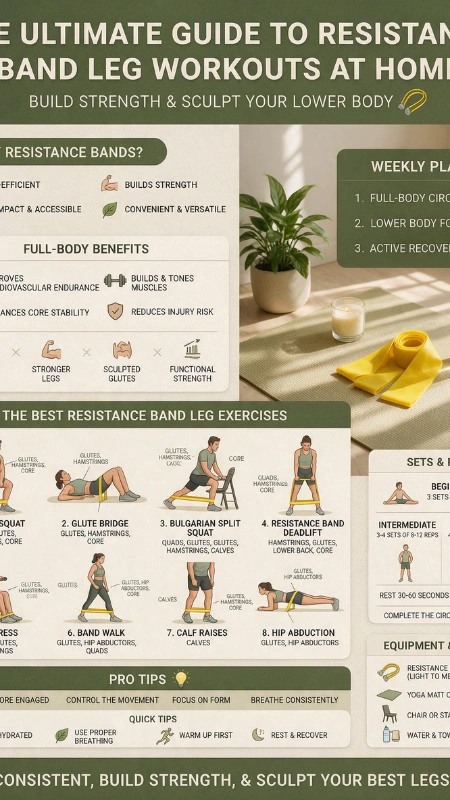
Why Choose Resistance Band Leg Workouts?
Resistance bands are lightweight, portable, and easy to store. They provide resistance as you stretch the band, allowing you to train several lower-body muscle groups with minimal equipment.
Here are some reasons to include them in your fitness routine:
- Convenience: Exercise at home, while traveling, or in a small workout space.
- Adjustable resistance: Choose a lighter band when learning a movement and increase resistance as your technique improves.
- Exercise variety: Perform squats, glute bridges, lunges, hip abductions, and other lower-body movements.
- Affordable equipment: A basic set of bands can provide several resistance options without requiring large machines.
- Strength-training support: Bands can help you build a consistent routine that challenges your muscles.
Resistance bands are not automatically better than free weights. Both can be useful tools, and the best choice depends on your goals, experience, and available equipment.
For broader fitness guidance, see the other articles in our Exercise & Fitness category.
Which Resistance Band Should You Use?
Resistance bands come in several styles. The best option depends on the exercise and your experience.
| Band type | Best use |
|---|---|
| Mini loop band | Glute bridges, squats, and hip abductions |
| Long loop band | Romanian deadlifts and some standing exercises |
| Tube band with handles | Exercises that require a comfortable grip |
| Light resistance band | Beginners and controlled technique practice |
| Medium or heavy band | More resistance for exercises you can already perform correctly |
Start with a band that lets you complete each repetition with control. If you cannot maintain good form, choose a lighter band. If every repetition feels very easy, consider a slightly stronger band.
Always inspect your band before exercising. Do not use one that has cracks, tears, or damaged handles.
6 Effective Resistance Band Leg Exercises
These six exercises cover several major lower-body muscle groups. Start with the easier variation when necessary, and focus on technique before increasing resistance.
1. Resistance Band Squats
Main muscles: Quadriceps, glutes, and other muscles that support the hips.
Resistance band squats are a practical way to train your legs at home. A mini loop band placed just above the knees can provide an additional challenge for maintaining knee position.
How to perform the exercise:
- Stand with your feet approximately shoulder-width apart.
- If using a mini loop band, place it just above your knees.
- Keep your chest lifted and your feet flat on the floor.
- Bend your hips and knees to lower yourself into a comfortable squat.
- Keep your knees aligned with the direction of your toes.
- Push through your feet to return to standing.
Beginner target: 2 sets of 8–12 repetitions.
Form tip: Lower only as far as you can while maintaining control. Your comfortable range of motion may differ from someone else’s.
2. Banded Glute Bridges
Main muscles: Glutes and supporting hip muscles.
Glute bridges are useful for training the muscles around your hips. A mini loop band above the knees adds resistance to the movement.
How to perform the exercise:
- Lie on your back with your knees bent and feet flat on the floor.
- Place the band above your knees.
- Position your feet approximately hip-width apart.
- Gently brace your abdominal muscles.
- Press through your feet and lift your hips.
- Keep your knees aligned with your feet without forcing them outward.
- Pause briefly, then lower your hips slowly.
Beginner target: 2 sets of 10–15 repetitions.
Form tip: Lift your hips using your glutes rather than arching your lower back. Stop at a height you can control comfortably.
3. Resistance Band Lunges
Main muscles: Quadriceps, glutes, and hamstrings.
Lunges train each leg individually and can help you practice balance and coordination. Beginners can start without a band before adding resistance.
How to perform the exercise:
- Stand upright with your feet hip-width apart.
- Take a comfortable step forward.
- Bend both knees while lowering your body under control.
- Keep your front foot flat and your front knee aligned with your toes.
- Push through your front foot to return to the starting position.
- Complete your repetitions, then switch legs.
If you want to add resistance, use a band designed for the exercise and follow its instructions for secure placement.
Beginner target: 2 sets of 6–10 repetitions per leg.
Easier variation: Hold a wall or sturdy support for balance, or perform a split squat with your feet remaining in place.
4. Banded Romanian Deadlifts
Main muscles: Hamstrings, glutes, and supporting muscles of the hips and trunk.
The Romanian deadlift uses a hip-hinge movement. A suitable long resistance band can provide resistance as you straighten your hips.
How to perform the exercise:
- Stand on the middle of a long resistance band with your feet about hip-width apart.
- Hold the ends securely, following the band’s instructions.
- Keep your knees slightly bent.
- Push your hips backward while keeping your back in a comfortable, neutral position.
- Lower your hands along the front of your thighs as far as your flexibility allows.
- Press your feet into the floor and move your hips forward to stand upright.
Beginner target: 2 sets of 8–12 repetitions.
Form tip: Think about moving your hips backward rather than bending deeply at your knees. Keep the band secure and avoid rounding your back to reach lower.
If the band slips or you cannot maintain your position, stop and use a simpler hip-hinge practice without resistance.
5. Standing Band Leg Abductions
Main muscles: Gluteus medius and other muscles that move the leg away from the body’s midline.
This exercise targets the muscles along the sides of your hips. It can be useful as part of a balanced lower-body routine.
How to perform the exercise:
- Place a mini loop band around your legs, above your knees or around your ankles, according to your ability and the band’s instructions.
- Stand tall and hold a sturdy support if needed.
- Keep your standing knee slightly relaxed.
- Move one leg out to the side without leaning your torso.
- Pause briefly, then return your leg slowly.
- Complete the repetitions and switch sides.
Beginner target: 2 sets of 10–12 repetitions per leg.
Form tip: Use a small, controlled movement. Avoid swinging your leg or rotating your hips to create extra range.
6. Resistance Band Hamstring Curls
Main muscles: Hamstrings at the back of your thighs.
Hamstring curls train knee flexion, an important movement pattern for the muscles at the back of the legs.
How to perform the exercise:
- Secure a suitable resistance band to a stable anchor specifically appropriate for exercise use.
- Attach the other end securely around your ankle using the band’s intended attachment.
- Stand facing the anchor and hold a stable support.
- Begin with your knee slightly bent or in the position recommended for your band setup.
- Bend your knee to bring your heel toward your glutes.
- Return slowly to the starting position.
- Complete your repetitions, then switch legs.
Beginner target: 2 sets of 8–12 repetitions per leg.
Form tip: Keep your thigh relatively still and avoid arching your back. Never attach a band to a weak or unstable object, and do not use a setup that could release suddenly.
If you do not have a safe anchor, skip this exercise and use glute bridges or another movement you can perform securely.
Beginner Resistance Band Leg Workout Plan
Use the following routine as a starting point. It covers the major lower-body muscle groups without requiring you to perform every possible band exercise in one session.
| Exercise | Sets | Repetitions |
|---|---|---|
| Resistance Band Squats | 2 | 8–12 |
| Banded Glute Bridges | 2 | 10–15 |
| Resistance Band Lunges | 2 | 6–10 per leg |
| Banded Romanian Deadlifts | 2 | 8–12 |
| Standing Band Leg Abductions | 2 | 10–12 per leg |
Rest for approximately 60–90 seconds between sets, or longer if you need it to maintain good technique. You can initially leave out one or two exercises if the full routine feels too challenging.
Perform the workout about twice a week on nonconsecutive days, allowing recovery between sessions. As you become more comfortable, adjust the number of sets or the resistance gradually.
For general guidance on weekly activity and muscle-strengthening exercise, read the CDC’s recommendations for adding physical activity as an adult.
How to Progress Safely
You do not need to make every workout harder. Consistent practice and gradual adjustments are more useful than rushing to a stronger band.
Try these strategies:
- Improve your technique first: Perform each movement through a comfortable range without swinging or losing balance.
- Add repetitions gradually: If your current set feels manageable, add one or two repetitions.
- Increase resistance carefully: Move to a stronger band when you can complete your planned repetitions with control.
- Adjust one variable at a time: Increase repetitions, sets, or resistance rather than changing everything at once.
- Keep a simple record: Note the band you used, the number of sets, and how difficult the workout felt.
- Allow recovery: Give your muscles time to recover, especially if you are new to strength training.
Progress varies from person to person. You may notice that movements become easier before you see visible changes in muscle size or body composition.
Common Mistakes to Avoid
A resistance band can only provide useful training when you can control the movement safely.
Watch out for these common mistakes:
- Using excessive resistance: A band that is too strong can make you compensate with poor technique.
- Moving too quickly: Fast, uncontrolled repetitions can reduce your ability to maintain the intended movement.
- Ignoring band placement: A band that rolls, slips, or is attached incorrectly can interrupt the exercise.
- Allowing the knees to collapse inward: During squats and lunges, keep your knees aligned with the direction of your toes.
- Arching your lower back: During hip bridges and hip hinges, avoid forcing your back into an exaggerated arch.
- Skipping recovery: Training hard every day without adequate rest can make consistency more difficult.
- Expecting spot reduction: Leg exercises strengthen muscles, but they do not selectively remove fat from the thighs or hips.
Use a lighter band or a simpler variation whenever you cannot maintain control.
Safety Tips for Home Workouts
Before beginning your session, spend a few minutes warming up with easy walking, gentle marching, or comfortable bodyweight movements.
Follow these precautions:
- Check the band for wear before every workout.
- Use only secure anchors and attachments designed for resistance-band exercise.
- Keep your movements smooth and avoid allowing the band to snap back.
- Exercise in a clear space with enough room to move.
- Stop if you experience sharp pain, dizziness, or unusual symptoms.
- If you have a current injury, persistent joint pain, or a health condition that affects exercise, seek advice from a qualified healthcare professional before starting a new routine.
Muscle effort is normal during strength training, but sharp or worsening pain is not something to push through.
Nutrition Tips for Muscle Recovery
Exercise is only one part of a balanced fitness routine. Eating enough food, including protein-rich foods, and getting adequate sleep can support recovery after strength training.
Consider including a variety of foods in your daily meals:
- Protein sources: Eggs, fish, poultry, beans, lentils, tofu, yogurt, and other protein-rich foods.
- Carbohydrate sources: Oats, potatoes, whole grains, fruit, and other foods that help provide energy.
- Vegetables and fruit: A range of colorful options to provide fiber, vitamins, and minerals.
- Fluids: Drink water regularly and adjust your intake to your activity level and conditions.
You do not need a special supplement or a complicated meal plan to begin exercising. Your overall eating pattern matters more than any single food.
For more practical food ideas, explore our healthy recipes and choose meals that fit your preferences and needs.
Frequently Asked Questions
Are resistance band leg workouts effective?
Resistance band exercises can help strengthen the legs and glutes when the resistance is appropriate and the movements are performed consistently. Results depend on your starting fitness level, training effort, recovery, and progression.
Can I build leg muscles with resistance bands at home?
Yes, resistance bands can provide a useful challenge for many lower-body exercises. As your strength improves, you may need stronger bands, more challenging variations, or additional resistance to keep progressing.
How often should I do resistance band leg workouts?
For many beginners, two sessions per week on nonconsecutive days are a practical starting point. Adjust the frequency according to your experience, recovery, and other physical activities.
Can resistance band exercises help reduce thigh fat?
These exercises can strengthen the muscles in your legs, but they cannot target fat loss from a specific body area. Changes in body fat depend on several factors, including overall eating habits, activity, sleep, and individual differences.
Do I need different resistance bands for different exercises?
Not necessarily. One suitable band may be enough to get started, but different exercises and muscle groups may require different resistance levels. A small set with several resistance options can offer more flexibility.
Are resistance band leg workouts suitable for beginners?
They can be, provided you choose manageable resistance and learn each movement carefully. Start with simple variations, use support when needed, and increase difficulty gradually.
Final Thoughts
Resistance band leg workouts offer a convenient way to train your lower body at home. Squats, glute bridges, lunges, Romanian deadlifts, leg abductions, and hamstring curls can help you build a varied routine with relatively little equipment.
Start with a manageable workout, focus on controlled repetitions, and allow time for recovery. As your technique and strength improve, adjust the resistance or repetitions gradually.
The most useful workout is one you can perform safely and maintain consistently. Choose exercises that fit your ability, pay attention to how your body responds, and make steady progress one session at a time.
Disclaimer: This article is for general educational purposes and is not medical or professional advice. Please consult a qualified healthcare professional before making changes to your diet, exercise, or health routine. See our Medical Disclaimer.