
Have you ever felt like your core just isn’t doing its job?
Maybe your lower back tightens after a long day at your desk. Maybe traditional sit-ups strain your neck. Or maybe you want stronger abs—but without complicated gym machines or intense routines that leave you sore for days.
Here’s the good news: you don’t need a fancy setup to build serious core strength. You just need a stability ball—and the right approach.
Table of Contents
When you start doing exercises with stability ball for abs, something shifts. Your body wakes up. Muscles you didn’t even realize you had begin working together. You’re not just chasing a flatter stomach—you’re building strength that supports your spine, improves balance, and makes everyday movement easier.
Let’s walk through exactly how you can get started.
Why Choose Exercises with Stability Ball for Abs?
If you’ve only done floor crunches, you might wonder what makes a stability ball so effective.
The answer is simple: instability.
When you sit, lean, or balance on a stability ball, your body has to constantly adjust to stay upright. That subtle wobble forces your deep core muscles to activate—especially the transverse abdominis, the muscle responsible for real core stability.
Key Benefits You’ll Notice
- ✅ Greater core activation than traditional crunches
- ✅ Improved balance and coordination
- ✅ Reduced strain on your lower back
- ✅ Better posture over time
- ✅ Functional strength for daily activities
Research published in the Journal of Strength and Conditioning Research shows that performing core exercises on unstable surfaces increases muscle activation compared to stable floor movements. In practical terms, this means you’re getting more engagement from the same movement.
And if you’re a beginner? That’s even better. The ball helps guide your range of motion and reduces pressure on your spine.
How Stability Ball Exercises Improve Core Strength
When you perform exercises with stability ball for abs, you’re not just targeting your “six-pack” muscles. You’re training your entire core system.
Muscles You Activate
- Rectus abdominis – the visible front abdominal muscles
- Transverse abdominis – deep stabilizing muscle
- Internal and external obliques – side abs
- Erector spinae – lower back muscles
- Glutes and hip flexors – pelvic stabilizers
The stability ball forces these muscles to work together. That teamwork improves posture, reduces injury risk, and enhances athletic performance—even if you’re not an athlete.
Why Beginners See Fast Progress
When you’re new to core training, your body adapts quickly. Within a few weeks of consistent stability ball workouts, you may notice:
- Better balance
- Stronger plank holds
- Reduced lower back discomfort
- Improved body awareness
It’s not about doing more—it’s about doing it right.
Best Stability Ball Exercises for Beginners
For more exercise ideas and guidance on proper technique, explore the ACE Exercise Library to learn about different movements and training options.
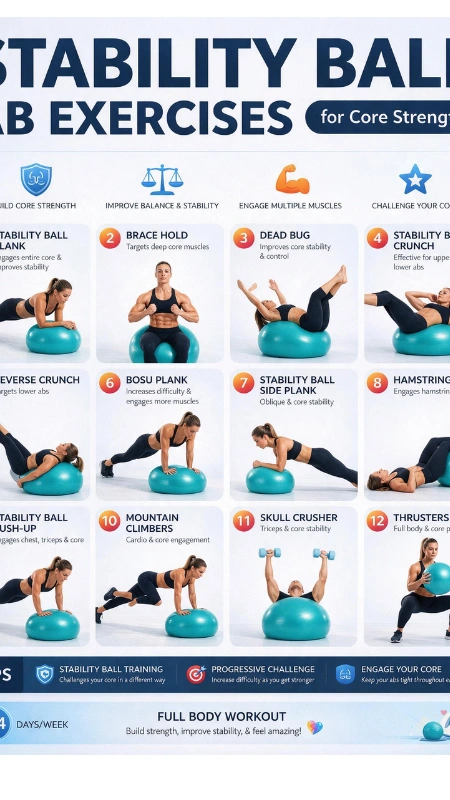
Let’s get into the practical side. These are the most effective beginner-friendly exercises with stability ball for abs.
1. Stability Ball Crunch
This is the perfect starting point.
How to do it:
- Sit on the ball and walk your feet forward until your lower back rests on the ball.
- Keep feet flat and hip-width apart.
- Cross arms over your chest.
- Engage your abs and lift your shoulders slightly.
- Lower back down slowly.
Why it works:
The ball supports your spine and increases your range of motion compared to floor crunches.
Pro Tip: Move slowly. The slower you go, the more your abs work.
2. Stability Ball Plank
If regular planks feel too easy, this will change that.
Steps:
- Place your forearms on the ball.
- Extend your legs behind you.
- Keep your body in a straight line.
- Tighten your core and hold.
Start with 20 seconds and build from there.
The ball shifts slightly under your weight, forcing constant core engagement.
3. Stability Ball Leg Raises
This move targets your lower abs.
How to perform:
- Lie on your back.
- Hold the ball between your feet.
- Lift your legs toward the ceiling.
- Lower slowly without arching your back.
Lowering with control is where the real work happens.
4. Wall Squat with Stability Ball
This exercise builds both leg and core strength.
Instructions:
- Place the ball between your lower back and a wall.
- Stand with feet shoulder-width apart.
- Slowly squat down.
- Push back up through your heels.
Your core stays engaged to keep the ball stable.
5. Stability Ball Roll-Out (Beginner Version)
This is a powerful core-builder.
Steps:
- Kneel on the floor.
- Rest forearms on the ball.
- Slowly roll the ball forward.
- Keep your hips from sagging.
- Pull back using your abs.
This movement trains deep core stability like few others.
Beginner Stability Ball Workout Plan
Here’s a simple routine you can follow three times per week.
| Exercise | Sets | Reps | Rest |
|---|---|---|---|
| Ball Crunch | 3 | 12–15 | 30 sec |
| Ball Plank | 3 | 20–40 sec | 30 sec |
| Wall Squat | 3 | 12 | 30 sec |
| Ball Roll-Out | 2–3 | 8–10 | 45 sec |
Consistency matters more than intensity. Focus on proper form before increasing reps.
Nutrition Support for Core Strength
You can’t out-train a poor diet. If you want visible results from your exercises with stability ball for abs, your nutrition must support your effort.
Here are two beginner-friendly options.
High-Protein Recovery Smoothie
| Ingredient | Quantity | Why It Helps |
|---|---|---|
| Greek Yogurt | 1 cup | Supports muscle repair |
| Banana | 1 | Restores glycogen |
| Almond Butter | 1 tbsp | Healthy fats for satiety |
| Spinach | 1 handful | Micronutrients |
| Almond Milk | 1 cup | Smooth texture & hydration |
Blend and enjoy post-workout.
Core-Boosting Oatmeal Bowl
| Ingredient | Quantity | Why It Helps |
|---|---|---|
| Rolled Oats | ½ cup | Sustained energy |
| Chia Seeds | 1 tbsp | Fiber & omega-3 |
| Blueberries | ½ cup | Antioxidants |
| Honey | 1 tsp | Natural sweetness |
| Protein Powder | 1 scoop | Muscle support |
Fueling properly enhances muscle recovery and fat metabolism.
Common Mistakes to Avoid
Even the best exercises can lose effectiveness if done incorrectly.
Watch out for:
- ❌ Arching your lower back
- ❌ Holding your breath
- ❌ Moving too quickly
- ❌ Using the wrong ball size
- ❌ Neglecting core engagement
When seated on the ball, your knees should form a 90-degree angle. That’s how you know it’s the correct size.
Safety Tips for Beginners
Your goal is progress—not injury.
- Warm up before starting
- Use a wall for extra balance if needed
- Engage your core before every movement
- Stop immediately if you feel sharp pain
- Consult your doctor if you have existing back issues
Your core should feel challenged—not strained.
Frequently Asked Questions About Exercises with Stability Ball for Abs
Are exercises with stability ball for abs effective for beginners?
Absolutely. They’re low-impact and activate deep stabilizing muscles better than many traditional ab exercises.
How often should you do exercises with stability ball for abs?
Three to four times per week works well for most beginners. Rest days allow muscles to recover and grow stronger.
Can exercises with stability ball for abs help reduce belly fat?
They strengthen and tone abdominal muscles. For fat loss, combine them with a calorie-controlled diet and regular cardio.
What size stability ball should you use?
- 55 cm if you’re 5’1″–5’7″
- 65 cm if you’re 5’8″–6’2″
- 75 cm if you’re taller than 6’3″
What Results Can You Expect?
If you stay consistent for 6–8 weeks, you may notice:
- Stronger core stability
- Better posture
- Reduced lower back discomfort
- Improved balance
- A firmer midsection
Visible abs depend largely on body fat percentage—but strength comes first.
Your Next Step
You don’t need a complicated program. You don’t need hours at the gym.
You need commitment—and a stability ball.
Start with just 15–20 minutes, three times a week. Focus on control. Pay attention to how your body feels. Track your progress.
Your future self—the one with stronger posture, better balance, and a more confident core—will thank you.
So roll out your stability ball today and begin.
Your core strength journey starts now.
Disclaimer: This article is for general educational purposes and is not medical or professional advice. Please consult a qualified healthcare professional before making changes to your diet, exercise, or health routine. See our Medical Disclaimer.