
There’s a special kind of exhaustion that comes with caring for a 3-month-old. You love your baby deeply—but you’re also running on broken sleep, cold coffee, and constant questions.
One of the biggest ones on your mind is probably this: how much should my 3 month old sleep?
If your baby sleeps “too much,” you worry. If they barely nap, you worry. If your friend’s baby sleeps through the night and yours doesn’t, you really worry.
Table of Contents
Take a breath. You’re not alone—and more importantly, you’re not doing anything wrong. Let’s walk through what’s normal, what’s not, and how you can gently support better sleep without driving yourself crazy.
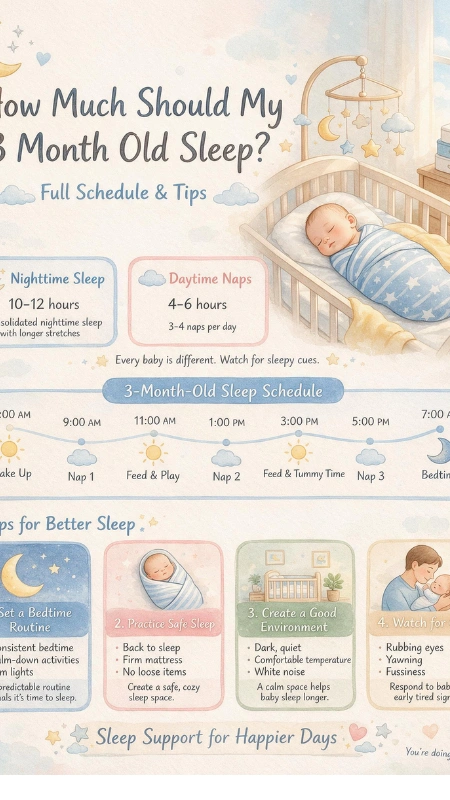
How Much Should a 3-Month-Old Baby Sleep in 24 Hours?
Sleep needs vary from baby to baby at 3 months of age. Rather than aiming for one exact number of hours, look at your baby’s overall sleep pattern, feeding, growth, and alertness.
Sleep-duration recommendations can differ by age. The American Academy of Sleep Medicine recommends 12–16 hours of sleep per 24 hours for infants aged 4–12 months, including naps. This recommendation does not establish a specific target for babies younger than 4 months.
If you are concerned that your baby is sleeping unusually little or much, is difficult to wake for feeds, is feeding poorly, or is not gaining weight as expected, contact your pediatrician for advice.
Remember that a sample schedule is a flexible guide, not a strict rule. Your baby’s individual needs and your pediatrician’s guidance should come first.
What Does a Normal 3-Month-Old Sleep Schedule Look Like?
At 3 months, your baby is transitioning from newborn chaos into more predictable rhythms. You might start noticing patterns forming.
Typical Daily Sleep Breakdown
| Time of Day | Sleep Type | Average Duration |
|---|---|---|
| Morning | Nap 1 | 1–2 hours |
| Midday | Nap 2 | 1–2 hours |
| Afternoon | Nap 3 | 30–90 minutes |
| Late Afternoon (sometimes) | Nap 4 | 30–45 minutes |
| Night | Night Sleep | 9–12 hours (with wake-ups) |
Most 3-month-olds:
- Take 3 to 4 naps
- Stay awake for 60–90 minutes at a time
- Begin stretching one longer sleep block at night
If your baby naps for 30 minutes and wakes up happy, that’s not automatically a problem. Short naps are common at this age because sleep cycles are still maturing.
Why Sleep Feels Different at 3 Months
You might have noticed something shifting recently. Maybe your baby:
- Suddenly wakes more often
- Fights naps they used to take easily
- Seems more alert and distracted
This is completely normal.
Around 3 months, your baby’s brain is undergoing rapid development. Their sleep cycles begin changing from newborn-style sleep to more adult-like patterns. This means:
- They cycle through lighter and deeper sleep
- They’re more aware of their surroundings
- They may wake fully between cycles
Some babies even show early signs of the well-known 4-month sleep regression.
It’s not a step backward. It’s growth.
Signs Your 3-Month-Old Is Getting Enough Sleep
Instead of obsessing over exact hours, look at the whole picture.
Healthy Sleep Indicators
Your baby likely gets enough rest if they:
- Wake up calm or playful
- Engage with faces and voices
- Feed effectively
- Fall asleep within 10–20 minutes
- Have predictable fussy periods rather than all-day crankiness
Signs of Overtiredness
On the other hand, your baby may need more sleep if you notice:
- Frequent meltdowns
- Arching back while crying
- Rubbing eyes or pulling ears
- Short naps followed by fussiness
- Difficulty settling even when clearly tired
Overtired babies often fight sleep harder. That’s because cortisol (a stress hormone) rises when they stay awake too long.
Watching wake windows can help prevent this spiral.
Understanding Wake Windows at 3 Months
A wake window is the amount of time your baby can comfortably stay awake between sleeps.
For a 3-month-old, that’s usually:
- 60 to 90 minutes
This includes:
- Feeding
- Diaper changes
- Tummy time
- Play
- Wind-down time
If your baby consistently melts down around the 75-minute mark, that’s your cue. Start the wind-down routine before you hit the edge.
How to Support Healthy Sleep at 3 Months
You can’t force your baby to sleep—but you can create conditions that make sleep easier.
1. Create a Simple Bedtime Routine
Your routine doesn’t need to be elaborate. It just needs to be predictable.
Here’s an example:
| Step | Activity | Why It Helps |
|---|---|---|
| 1 | Warm bath | Signals transition to nighttime |
| 2 | Fresh diaper & pajamas | Comfort + routine cue |
| 3 | Feeding | Full tummy supports longer stretches |
| 4 | Dim lights & soft voice | Encourages melatonin production |
| 5 | Into crib drowsy | Builds sleep independence |
Keep it consistent and calm. Within a week or two, your baby will start recognizing the pattern.
2. Encourage Day-Night Differentiation
At 3 months, your baby’s circadian rhythm is still developing.
During the day:
- Open curtains
- Keep normal household noise
- Interact and play
At night:
- Keep lights dim
- Speak softly
- Avoid stimulating interaction
This subtle contrast helps your baby learn when it’s time to be awake—and when it’s not.
3. Don’t Rush to Drop Night Feeds
If you’re wondering how much should my 3 month old sleep without waking, here’s the honest answer:
Many babies still need 1–3 night feeds.
Longer stretches (4–6 hours) may happen, but sleeping through the night isn’t required—or expected—at this age.
Always check with your pediatrician before eliminating night feeds.
The Connection Between Nutrition and Sleep
Your baby’s sleep is closely linked to feeding patterns.
At 3 months:
- Most babies eat every 3–4 hours during the day
- Cluster feeding in the evening is common
- Growth spurts can temporarily disrupt sleep
If your baby wakes more often, ask yourself:
- Are they going through a growth spurt?
- Did they get full feeds during the day?
- Are they distracted during daytime feeding?
Sometimes improving daytime intake improves nighttime stretches.
A Simple Evening Snack for Breastfeeding Moms
If you’re breastfeeding, your own nutrition matters too. Stable blood sugar and adequate nutrients can support steady milk supply and energy levels.
Here’s a gentle evening option:
Banana Oat Lactation Smoothie
| Ingredient | Amount | Benefit |
|---|---|---|
| Banana | 1 medium | Contains magnesium for relaxation |
| Rolled oats | ¼ cup | Traditionally supports milk supply |
| Almond butter | 1 tbsp | Healthy fats for sustained energy |
| Milk (or oat milk) | 1 cup | Calcium for muscle function |
| Cinnamon | Pinch | May help regulate blood sugar |
Blend and enjoy 30–60 minutes before bed.
This isn’t a magic sleep support—but it supports your body while you support your baby.
Safe Sleep Guidelines You Shouldn’t Ignore
No matter how tired you are, safety comes first.
Follow the ABCs of safe sleep:
- Alone (no loose blankets or toys)
- Back (always place baby on their back)
- Crib (firm mattress, fitted sheet only)
Additional safety tips:
- Share a room, not a bed, for the first 6 months
- Keep room temperature between 68–72°F
- Avoid weighted blankets or sleep positioners
Better sleep is helpful. Safe sleep is essential.
When to Talk to Your Pediatrician
Most sleep variations at 3 months are normal. But you should reach out if:
- Your baby consistently sleeps fewer than 11 total hours
- They seem unusually lethargic
- You notice loud snoring or breathing pauses
- They’re not gaining weight appropriately
Trust your instincts. If something feels off, it’s worth asking.
Frequently Asked Questions
How much should my 3 month old sleep at night?
Most 3-month-olds sleep between 9 and 12 hours at night, though they usually wake 1–3 times for feeding. Longer uninterrupted stretches may happen but aren’t expected.
How much should my 3 month old sleep without waking?
It’s common for babies this age to sleep 3 to 6 hours at a time. Some manage longer stretches, but frequent waking can still be developmentally normal.
Is 12 hours enough when asking how much should my 3 month old sleep?
Twelve total hours per day is generally on the low end. Most experts recommend 14–17 hours within 24 hours. However, behavior and growth matter more than a single number.
Why does my 3 month old fight sleep?
Common reasons include:
- Overtiredness
- Overstimulation
- Growth spurts
- Early sleep cycle changes
Shortening wake windows often improves resistance.
The Truth About Comparing Babies
It’s tempting to measure your baby’s sleep against someone else’s.
But here’s what you don’t see:
- The night wakings they don’t post about
- The nap battles behind the scenes
- The developmental differences between babies
Sleep isn’t a competition. It’s a biological process unfolding at its own pace.
Your job isn’t to force perfect sleep.
It’s to create a safe, supportive environment and respond with consistency.
That’s enough.
Final Thoughts: Trust the Range, Trust Yourself
So—how much should my 3 month old sleep?
The short answer:
Around 14–17 hours per day, including naps and nighttime sleep.
The longer answer:
Enough that they’re growing, engaging, feeding well, and not chronically overtired.
If you’re watching wake windows, keeping routines consistent, and following safe sleep practices, you’re doing your part.
This stage won’t last forever—even if the nights feel long right now.
💬 Now I’d Love to Hear From You
How many hours is your 3-month-old sleeping right now?
Are naps the struggle—or nighttime wakings?
Drop your experience in the comments. Sharing your story might be exactly what another tired parent needs to read today.
Disclaimer: This article is for general educational purposes and is not medical or professional advice. Please consult a qualified healthcare professional before making changes to your diet, exercise, or health routine. See our Medical Disclaimer.