
The Heart of the Kitchen: An Opening Reflection
You know that specific feeling. It’s 7:00 PM on a Sunday, your kitchen counters are barely visible beneath mountains of fresh kale, roasted sweet potatoes, and perfectly seared chicken breasts. The rhythmic thwack-thwack-thwack of your chef’s knife against the wooden board is the only sound in the room. As you snap the final lid onto the thirtieth container, a sense of profound satisfaction washes over you. You aren’t just cooking; you’re preparing someone’s health, time, and sanity for the week ahead.
Table of Contents
But then, the “what ifs” start to creep in. You’ve had friends tell you for years that you should sell these meals. You’ve daydreamed about quitting your 9-to-5 to feed your community. Yet, the gap between your home kitchen and a legitimate storefront feels like a canyon. You worry about the red tape, the terrifying math of profit margins, and the logistics of delivery routes.
Here is the truth: your passion is the engine, but a meal prep business plan template is the steering wheel. Without it, you’re just driving in circles, burning fuel. This guide isn’t just about filling out a form; it’s about giving your culinary dream the skeleton it needs to stand upright and walk. Let’s turn your kitchen-table ambition into a scalable, profitable reality.
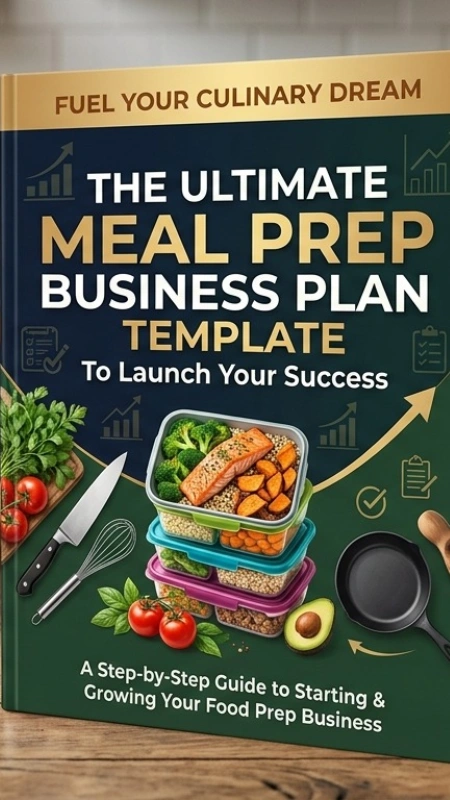
Why a Meal Prep Business Plan Template is Your Secret Ingredient
Think of your business plan as your most important recipe. You wouldn’t bake a complex soufflé by “winging it” the first time, would you? The food industry is notoriously thin on margins and heavy on regulations. Starting without a roadmap is a recipe for burnout.
When you sit down to fill out a meal prep business plan template, you are doing more than just organizing folders. You are stress-testing your ideas. You are asking yourself the hard questions before they become expensive mistakes.
- Clarity of Vision: You might think you want to “sell healthy food,” but a plan forces you to decide if you are a high-end keto service or an affordable family-style provider.
- Operational Efficiency: You’ll identify your “bottlenecks”—like having only one oven or a tiny refrigerator—before you take your first hundred orders.
- Financial Security: It moves you from “guessing” your prices to “knowing” your profit down to the penny.
- The Growth Factor: According to industry data from Grand View Research, the meal delivery sector is ballooning toward a multi-billion dollar valuation. To get a piece of that, you need a plan that looks professional to investors, landlords, and partners.
Section 1: Executive Summary – Defining Your Culinary Identity
The Executive Summary is your hook. If you were handing this to a bank manager or a potential partner, this is the only page they might read in full. It needs to drip with your brand’s personality while remaining strictly professional.
Mission and Vision Statements
Why are you doing this? If your answer is “to make money,” you’ll likely quit when the first fridge breaks at 3:00 AM. Your mission should be your “North Star.”
- Example: “To empower busy local families to reclaim their evenings by providing organic, chef-driven meals that require zero prep.”
The Legal Foundation
You need to decide how your business exists in the eyes of the law. Will you be a Sole Proprietorship, an LLC, or a S-Corp? For most starting a meal prep business, an LLC offers a good balance of liability protection and tax simplicity. Mention your Unique Selling Proposition (USP) here as well. What makes your “Lemon Herb Chicken” different from the one at the grocery store?
Section 2: Market Analysis – Finding Your Hungry Audience
You cannot be everything to everyone. If you try to feed the college student on a budget, the bodybuilder on a bulk, and the elderly neighbor on a low-sodium diet all at once, your kitchen will become a chaotic nightmare.
Target Demographics
Who is actually going to pull out their credit card?
- The Busy Professional: They have the money but zero time. They care about flavor and packaging that looks good in the office microwave.
- The Fitness Enthusiast: They care about macros (protein, carbs, fats) above all else.
- The Special Diet Seekers: People managing gluten-intolerance, Paleo, or Vegan lifestyles who struggle to find options elsewhere.
Competitive Landscape
Look at who is already operating in your zip code. Don’t just look at other meal prep companies; look at the “prepared foods” section of your local Whole Foods or the local healthy cafe. What are they charging? How long does their food stay fresh? Your meal prep business plan template should highlight the gap they are leaving wide open for you.
Section 3: The Menu – Curating Your Product Line
Your menu is your contract with your customer. In the meal prep world, you want a balance between “tried-and-true favorites” and “seasonal excitement.”
Signature Meal Examples
Choose 5 to 7 meals that define your brand. These should be items that hold up well after three days in a refrigerator. Avoid things like fried fish or delicate cream sauces that break down when reheated.
Recipe Costing Analysis Table
To stay in business, you must know your “Cost of Goods Sold” (COGS). Use a table like the one below to break down your expenses for a batch of 10 meals.
| Ingredient | Quantity (for 10 meals) | Source | Estimated Cost |
|---|---|---|---|
| Grass-Fed Ground Beef | 5 lbs | Local Butcher | $40.00 |
| Sweet Potatoes | 5 lbs | Wholesale Club | $7.00 |
| Fresh Asparagus | 3 lbs | Farmers Market | $12.00 |
| Packaging (BPA-free) | 10 units | Eco-Supply Co. | $5.50 |
| Spices/Oils/Aromatics | — | Pantry | $3.00 |
| Total Batch Cost | — | — | $67.50 |
| Cost Per Individual Meal | — | — | $6.75 |
If your cost is $6.75, and you want to maintain a healthy 30% food cost margin, you should be charging roughly $22.00 per meal. If that feels too high for your market, you must find cheaper ingredients or lower your overhead.
Section 4: Operational Plan – From Prep to Plate
This is where the rubber meets the road. Cooking for four people is a joy; cooking for forty is a logistical operation.
- The Kitchen Space: You likely cannot start in your home kitchen due to health department regulations. Look into Ghost Kitchens or Shared Commissary Kitchens. These allow you to rent licensed space by the hour.
- Permits and Licenses: You will need a Food Manager’s Certificate (like ServSafe), a Business License, and potentially a specialized delivery permit. Check your local health department’s “Blueprints for Food Service” guide.
- The Delivery Logistics:
- Zone Delivery: Only deliver to certain zip codes on specific days.
- Pickup Hubs: Partner with a local gym or coffee shop where customers can grab their bags. This saves you hours of driving and fuel costs.
Section 5: Marketing and Sales Strategy
If a tree falls in the forest and no one is there to hear it, does it make a sound? If you cook the world’s best lasagna but no one sees it on their feed, do you make a sale?
- The Power of Visuals
Food is eaten with the eyes first. You don’t need a $2,000 camera, but you do need natural light and a clean background for your photos. Your marketing strategy should center on “The Reveal”—showing the steam rising from a freshly opened container. - Subscription vs. A La Carte
Subscription models are the holy grail of meal prep. If you can get 50 people to commit to $100 a week, you have a guaranteed $5,000 in weekly revenue. This allows you to buy ingredients in bulk and reduces food waste. - Leveraging Local SEO
Ensure your website mentions your city and the phrase “meal prep service” frequently. When someone searches “healthy food delivery near me,” you want your kitchen to be the first name they see.
Section 6: Financial Projections and Funding
This is the part that makes most creatives want to hide in the walk-in freezer. But you need to face the numbers.
- Startup Costs: List everything. The $500 for the website, the $200 for the first month’s insurance, the $1,000 for initial packaging and ingredients.
- Burn Rate: How much money are you losing each month before you hit your break-even point? Knowing this number prevents you from running out of cash unexpectedly.
- Revenue Goals: Set milestones. “By Month 6, we will serve 150 meals per week.” This gives you a metric for success beyond just “feeling busy.”
Conclusion: Your Journey to the Table Starts Here
Building a food business is one of the most taxing, grueling, yet deeply rewarding paths you can take. You are providing the building blocks of life to your customers. By taking the time to flesh out this meal prep business plan template, you are showing yourself—and the world—that you are serious.
You have the recipes. You have the drive. Now, you have the structure. Don’t let another month go by where your dream stays tucked away in a recipe box. Open your laptop, start with the Executive Summary, and build the future you’ve been dreaming of. Your community is hungry; it’s time to feed them.
Ready to get cooking? Start drafting your Executive Summary today and take the first step toward food-industry freedom!
Frequently Asked Questions (FAQ)
What is the most important part of a meal prep business plan template?
While every section matters, the Financial Projections and Market Analysis are critical. You must prove that there is a demand for your specific style of cooking and that you can produce that food at a cost that allows for profit. Without these, your business is just an expensive hobby.
How much does it cost to start a meal prep business?
Startup costs can vary wildly. If you use a shared commissary kitchen and start with a small client list, you can launch for as little as $2,000 to $5,000. However, if you are looking to open your own dedicated facility with industrial equipment, you could be looking at $50,000 or more.
How do I handle food safety in a meal prep business plan?
Your plan should include a Standard Operating Procedure (SOP) for food safety. This includes how you monitor refrigerator temperatures, your “First-In, First-Out” (FIFO) method for ingredient rotation, and your plan for labeling containers with “Use By” dates.
Can I use a meal prep business plan template to get a loan?
Absolutely. Banks and the Small Business Administration (SBA) require a formal, written business plan before they will consider lending you money. A structured template ensures you provide the data in a format that lenders recognize and trust.
How often should I update my business plan?
Think of it as a living document. You should revisit your meal prep business plan template every six months. As food costs rise or as you discover a new niche (like a sudden demand for vegan keto meals), your plan should evolve to reflect the reality of your kitchen.