
An exercise bike can be a convenient way to become more active, improve cardiovascular fitness, and support long-term weight management.
Unlike outdoor cycling, stationary biking doesn’t require navigating traffic, checking the weather, or finding a safe route.
You can adjust the resistance, control your pace, and exercise at home or in a gym.
Table of Contents
For many beginners, stationary cycling is also a relatively low-impact form of aerobic activity because the bike supports much of your body weight.
But can using an exercise bike for weight loss actually make a difference?
Stationary cycling uses energy and can contribute to an overall weight-management plan. However, the amount of weight someone loses depends on many factors, including eating habits, activity levels, sleep, medications, and individual health circumstances.
This guide explains how stationary cycling works, which muscles it uses, how to estimate calorie expenditure, and how to begin safely.
You’ll also find a flexible four-week exercise bike routine and a beginner-friendly interval workout.
The goal is to help you build a sustainable activity habit rather than chase unrealistic calorie-burning targets.
exercise bike for weight loss
Can an Exercise Bike Help You Lose Weight?
Stationary cycling can support weight management because it increases physical activity and energy expenditure.
However, exercise alone does not support weight loss.
How Stationary Cycling Uses Energy
When you pedal, your muscles require energy to produce movement.
Your body supplies that energy through metabolic processes involving carbohydrates and fats.
The amount of energy used during a cycling session depends on several factors, including exercise intensity, duration, body size, and fitness level.
A longer or more demanding session generally requires more energy than a short, easy ride.
However, two people completing the same workout may burn different amounts of energy.
Why Weight Loss Depends on More Than Exercise
Weight loss generally occurs when energy intake is lower than energy expenditure over time.
Physical activity can contribute to that process.
However, appetite, food intake, sleep, medications, medical conditions, and physiological adaptations can influence weight changes.
According to NIH weight-management guidance, sustainable approaches typically combine appropriate eating habits, physical activity, and other lifestyle factors.
Stationary cycling should be viewed as one useful component rather than a expected weight-loss solution.
Benefits Beyond the Scale
Even when body weight remains stable, regular cycling can improve physical fitness.
Potential benefits include improved aerobic endurance, better exercise tolerance, and increased daily physical activity.
Exercise can also support mood and sleep quality for many people.
These outcomes can be meaningful regardless of changes on the scale.
Stationary Bicycle Exercise Benefits
Stationary cycling offers several practical advantages.
Low-Impact Cardiovascular Exercise
Cycling is generally considered low-impact because the feet remain supported by the pedals and the bike carries much of the rider’s body weight.
This can make it more comfortable than running for some people.
However, low-impact does not mean risk-free.
Poor bike fit, excessive resistance, or rapid increases in training volume can contribute to discomfort.
People with significant knee, hip, back, or cardiovascular conditions may need individualized guidance.
Improved Aerobic Fitness
Stationary cycling challenges the cardiovascular and respiratory systems.
With regular training, many people improve their ability to sustain physical activity.
The CDC recommends that adults aim for at least 150 minutes of moderate-intensity aerobic activity per week, or 75 minutes of vigorous-intensity activity, or an equivalent combination.
Adults are also advised to perform muscle-strengthening activities on at least two days per week.
Beginners do not need to reach these targets immediately.
Starting with shorter sessions and increasing gradually can be more manageable.
Convenience and Consistency
An exercise bike can be used indoors regardless of weather.
It also allows riders to control intensity and duration.
Some people find it easier to maintain a routine when exercise is available at home.
Consistency matters more than completing occasional extremely demanding workouts.
Lower-Body Muscle Engagement
Cycling repeatedly activates several lower-body muscles.
Resistance can increase the muscular effort required during pedaling.
However, stationary cycling is primarily an aerobic exercise.
It should not be treated as a complete replacement for strength training.
What Muscles Does a Stationary Bike Work?
Stationary cycling primarily involves the muscles of the lower body.
Different muscles contribute throughout the pedal stroke.
Quadriceps
The quadriceps are located at the front of the thighs.
They help extend the knee and contribute significantly during the downward pedaling phase.
Hamstrings
The hamstrings are located at the back of the thighs.
They assist with knee movement and contribute to pedaling mechanics.
Glutes
The gluteal muscles help extend and stabilize the hips.
They contribute to power production, particularly when resistance increases.
Calves
The calf muscles assist with ankle movement and stabilization during pedaling.
Core Muscles
The abdominal and back muscles help stabilize the torso.
Their involvement depends partly on bike type, posture, and riding intensity.
Cycling does not necessarily provide enough resistance to maximize muscle strength or size.
For broader fitness, combine cycling with appropriate resistance exercises.
How Many Calories Does an Exercise Bike Burn?
Calorie expenditure varies considerably.
Factors include body weight, effort, duration, fitness level, and the type of stationary bike.
The Compendium of Physical Activities assigns metabolic equivalent values, or METs, to different activities.
MET values can be used to estimate energy expenditure, but they do not measure an individual’s actual calorie burn.
Estimated Calories for 30 Minutes of Cycling
The following estimates use approximately 5 METs for moderate stationary cycling.
The calculation is:
Estimated calories = MET value × body weight in kilograms × duration in hours.
| Body Weight | Estimated Calories in 30 Minutes |
|---|---|
| 125 lb / 57 kg | 143 |
| 150 lb / 68 kg | 170 |
| 175 lb / 79 kg | 198 |
| 200 lb / 91 kg | 228 |
| 225 lb / 102 kg | 255 |
These figures represent approximate gross energy expenditure, including energy the body would use at rest during that period.
They are not measurements of additional calories burned above resting metabolism.
A different MET value or actual cycling workload would produce different estimates.
Why Bike Displays May Be Inaccurate
Some exercise bikes estimate calories using limited information.
If the machine does not account for body weight, actual power output, or other relevant variables, its estimate may be imprecise.
Even devices that use heart rate can produce errors.
Treat displayed calorie numbers as rough estimates rather than exact measurements.
Avoid using them as a precise basis for deciding how much to eat.
How to Set Up an Exercise Bike Correctly
A comfortable bike setup can make cycling more enjoyable and may reduce unnecessary strain.
Adjust Saddle Height
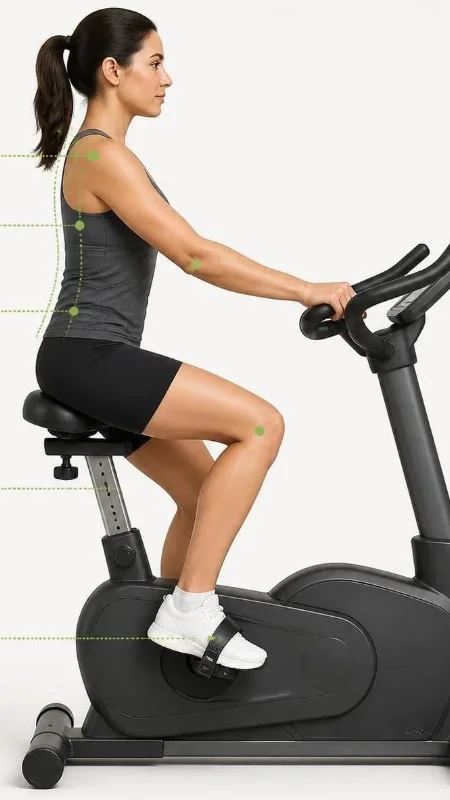
For an upright exercise bike, adjust the saddle so your knee remains slightly bent when the pedal is at its lowest position.
Avoid setting the seat so high that your hips rock from side to side.
A seat that is too low may increase knee flexion and discomfort.
Exact positioning depends on body proportions and bike design.
Adjust the Handlebars
Position handlebars so you can reach them comfortably without excessive rounding of the back or strain in the shoulders.
Beginners often prefer a relatively upright position.
Recumbent bikes have different adjustment requirements, so follow the manufacturer’s instructions.
Choose Comfortable Resistance
Start with resistance that allows smooth pedaling.
Avoid using the highest resistance simply because it feels more challenging.
If you need to sway, strain, or push excessively to turn the pedals, the resistance may be too high.
Warm Up
Begin each ride with approximately five minutes of easy pedaling.
Gradually increase the pace or resistance as you feel comfortable.
Finish with several minutes of easier cycling.
Four-Week Exercise Bike Plan for Beginners
This four-week plan is intended for adults who are new to stationary cycling and can participate in light-to-moderate exercise.
It is not designed for people who require medically supervised rehabilitation.
The plan gradually increases activity while allowing recovery days.
Use the talk test to judge intensity.
Easy effort: You can talk comfortably and breathe without difficulty.
Moderate effort: You can talk, but singing would be difficult.
Harder effort: Talking becomes challenging.
Beginners should generally emphasize easy and moderate efforts.
Week 1: Establish a Comfortable Routine
The first week focuses on learning bike setup and developing consistency.
| Day | Workout | Duration |
|---|---|---|
| Monday | Easy cycling | 15 minutes |
| Tuesday | Rest or gentle walking | Optional |
| Wednesday | Easy cycling | 15 minutes |
| Thursday | Rest | — |
| Friday | Easy cycling | 20 minutes |
| Saturday | Gentle walking or mobility | Optional |
| Sunday | Rest | — |
Weekly cycling total: 50 minutes.
Each session should include easy pedaling at the beginning and end.
The goal is to finish feeling capable of exercising again.
Week 2: Increase Riding Time
If Week 1 feels manageable, gradually increase session duration.
| Day | Workout | Duration |
|---|---|---|
| Monday | Easy-to-moderate cycling | 20 minutes |
| Tuesday | Rest or walking | Optional |
| Wednesday | Easy cycling | 20 minutes |
| Thursday | Rest | — |
| Friday | Moderate cycling | 25 minutes |
| Saturday | Easy cycling | 15 minutes |
| Sunday | Rest | — |
Weekly cycling total: 80 minutes.
Keep resistance manageable.
If your legs feel unusually fatigued or soreness persists, repeat Week 1 rather than increasing activity.
Week 3: Introduce Gentle Intervals
Intervals alternate between different effort levels.
They do not need to involve maximum-intensity exercise.
| Day | Workout | Duration |
|---|---|---|
| Monday | Moderate cycling | 25 minutes |
| Tuesday | Rest | — |
| Wednesday | Gentle interval workout | 25 minutes |
| Thursday | Walking or mobility | Optional |
| Friday | Moderate cycling | 25 minutes |
| Saturday | Easy cycling | 20 minutes |
| Sunday | Rest | — |
Weekly cycling total: 95 minutes.
During the interval session, alternate short periods of slightly faster pedaling with comfortable recovery periods.
Avoid sprinting.
Week 4: Build Consistency
The fourth week increases total cycling time while retaining recovery opportunities.
| Day | Workout | Duration |
|---|---|---|
| Monday | Moderate cycling | 30 minutes |
| Tuesday | Rest or walking | Optional |
| Wednesday | Beginner intervals | 30 minutes |
| Thursday | Rest | — |
| Friday | Moderate cycling | 30 minutes |
| Saturday | Easy cycling | 25 minutes |
| Sunday | Rest | — |
Weekly cycling total: 115 minutes.
This is still below the general 150-minute weekly moderate-intensity recommendation.
That is acceptable for a beginner progression.
Continue increasing activity gradually after Week 4 if your health, fitness, and schedule allow.
Beginner Exercise Bike Interval Workout
Intervals can provide variety and help improve aerobic fitness.
They are not automatically better for weight loss than steady cycling.
The total amount of activity and long-term consistency remain important.
25-Minute Beginner Interval Session
| Stage | Duration | Effort |
|---|---|---|
| Warm-up | 5 minutes | Easy |
| Interval 1 | 1 minute | Moderately challenging |
| Recovery | 2 minutes | Easy |
| Interval 2 | 1 minute | Moderately challenging |
| Recovery | 2 minutes | Easy |
| Interval 3 | 1 minute | Moderately challenging |
| Recovery | 2 minutes | Easy |
| Interval 4 | 1 minute | Moderately challenging |
| Recovery | 2 minutes | Easy |
| Interval 5 | 1 minute | Moderately challenging |
| Recovery | 2 minutes | Easy |
| Cool-down | 5 minutes | Easy |
Total duration: 25 minutes.
Step-by-Step Instructions
Step 1: Adjust the bike for a comfortable riding position.
Step 2: Pedal easily for five minutes.
Step 3: Increase your pace or resistance slightly for one minute.
Step 4: Return to easy pedaling for two minutes.
Step 5: Repeat the one-minute effort and two-minute recovery sequence five times.
Step 6: Finish with five minutes of gentle pedaling.
Step 7: Dismount carefully and allow your breathing to return toward normal.
Workout Details
- Preparation time: Approximately 5 minutes for bike setup.
- Workout time: 25 minutes.
- Total time: Approximately 30 minutes.
- Participants: 1.
- Equipment: Stationary exercise bike.
- Difficulty: Beginner to moderate.
If intervals cause dizziness, chest discomfort, unusual breathlessness, or significant pain, stop exercising and seek appropriate medical attention.
How Often Should You Use an Exercise Bike for Weight Management?
The best schedule is one you can maintain safely.
For beginners, cycling three times per week may be a manageable starting point.
As endurance improves, riding four or five times per week may be appropriate.
The CDC recommends at least 150 minutes of moderate-intensity aerobic activity weekly for adults, along with two days of muscle-strengthening activities.
More activity may provide additional benefits, but increases should be gradual.
You can also combine cycling with walking, swimming, or other activities.
For another accessible cardio option, explore our guide on how long to walk to lose weight.
Common Exercise Bike Mistakes to Avoid
Starting Too Hard
Beginners sometimes assume that every workout should be exhausting.
However, overly demanding sessions can make recovery difficult and reduce consistency.
Begin at a manageable intensity.
Using Excessive Resistance
Very high resistance can encourage poor pedaling mechanics.
Choose resistance that allows controlled movement.
Ignoring Bike Fit
An uncomfortable saddle or incorrect seat height can contribute to knee, hip, or back discomfort.
Adjust the bike before each session.
Holding the Handlebars Too Tightly
Excessive gripping can create unnecessary tension in the shoulders and arms.
Maintain a comfortable grip and relaxed upper body.
Focusing Only on Calories
Calorie displays are estimates.
Progress can also be measured through improved endurance, greater comfort, and the ability to complete workouts consistently.
Skipping Strength Training
Cycling primarily trains aerobic endurance and lower-body movement.
Strength training supports muscular strength and broader physical function.
Include appropriate resistance exercises when possible.
Exercise Bike Safety and Recovery
Stationary cycling is suitable for many adults, but exercise recommendations should reflect individual health circumstances.
People with known cardiovascular disease, significant joint problems, recent surgery, or other conditions affecting exercise tolerance may need professional guidance.
Stop exercising if you experience chest pain, faintness, severe shortness of breath, or other concerning symptoms.
Seek urgent medical care for potentially serious symptoms.
Drink fluids according to thirst and activity conditions.
Allow recovery between challenging workouts.
Adequate sleep and appropriate nutrition can also support training.
The USDA MyPlate framework provides general guidance for building balanced meals with vegetables, fruit, grains, protein foods, and dairy or fortified alternatives.
There is no need to follow an extreme diet simply because you begin cycling.
Frequently Asked Questions About Exercise Bikes for Weight Loss
Is 30 Minutes on an Exercise Bike Enough to Lose Weight?
Thirty minutes of stationary cycling can contribute to daily physical activity and energy expenditure.
However, whether someone loses weight depends on overall energy balance and individual circumstances.
Thirty-minute sessions can be a useful part of a regular exercise routine.
Is It Better to Cycle Every Day?
Daily easy cycling may be manageable for some people.
However, beginners generally benefit from recovery days, particularly when increasing exercise duration or intensity.
The best schedule depends on fitness level, health status, and recovery.
Is an Exercise Bike Better Than Walking for Weight Loss?
Neither activity is universally better.
Cycling and walking can both support cardiovascular fitness and weight management.
The more suitable choice depends on accessibility, comfort, preferences, and the ability to remain consistent.
Does Stationary Cycling Burn Belly Fat?
Stationary cycling uses energy and can contribute to overall fat loss when combined with an appropriate eating pattern.
However, it cannot selectively remove fat from the abdomen.
Where the body loses fat is influenced by genetics and other factors.
What Resistance Should Beginners Use?
Begin with low-to-moderate resistance that allows smooth, controlled pedaling.
Increase resistance gradually as fitness improves.
Avoid using resistance that causes straining or joint discomfort.
Can an Exercise Bike Build Muscle?
Stationary cycling works the quadriceps, hamstrings, glutes, and calves.
It can improve muscular endurance.
However, substantial muscle growth generally requires progressive resistance training.
Cycling should not replace all strength exercises.
How Long Does It Take to See Results?
Improvements in comfort and endurance may occur over several weeks of consistent training.
Changes in body weight vary considerably and cannot be predicted reliably from cycling duration alone.
Focus on sustainable progress rather than expecting a specific result after four weeks.
Final Thoughts: Build a Sustainable Cycling Routine
An exercise bike can be a practical tool for becoming more active, improving aerobic fitness, and supporting weight-management goals.
Its main advantages are convenience, adjustable intensity, and relatively low-impact movement.
The four-week plan in this guide provides a gradual starting point, while the beginner interval workout offers a way to introduce variety.
Remember that using an exercise bike for weight loss does not support a particular change in body weight.
The most useful approach combines regular physical activity with balanced nutrition, adequate recovery, and realistic expectations.
Start with manageable sessions, increase gradually, and choose a routine you can maintain.
For more activity ideas, explore our Exercise for Weight Loss collection.
References and Further Reading
- CDC — Physical Activity Basics. https://www.cdc.gov/physical-activity-basics/
- U.S. Department of Health and Human Services — Move Your Way. https://health.gov/moveyourway/
- NIH NIDDK — Weight Management. https://www.niddk.nih.gov/health-information/weight-management
- NIH National Heart, Lung, and Blood Institute. https://www.nhlbi.nih.gov/
- USDA MyPlate. https://www.myplate.gov/
- Compendium of Physical Activities. https://pacompendium.com/
Disclaimer: This article is for general educational purposes and is not medical or professional advice. Please consult a qualified healthcare professional before making changes to your diet, exercise, or health routine. See our Medical Disclaimer.