
You finally make room for a workout, pick up a resistance band, and pause. Are curls enough? Which weight should you use? And how do you know whether you’re making progress?
Table of Contents
If that sounds familiar, you don’t need a more complicated routine. You need clear instructions and a starting point that fits your life.
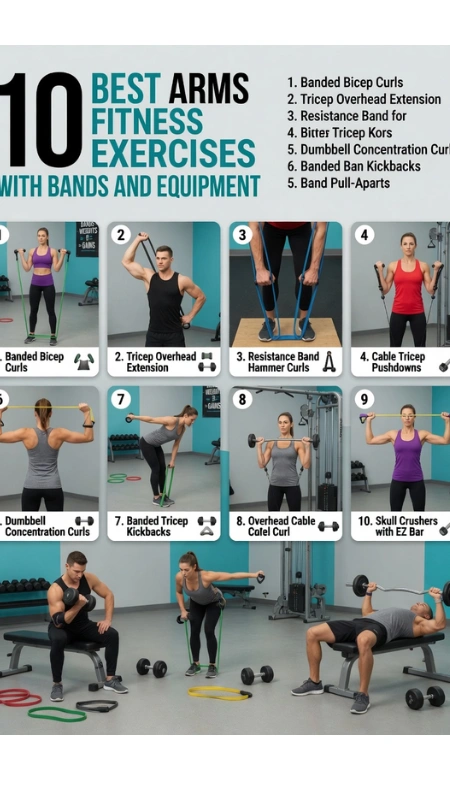
These ten arms fitness exercises cover resistance bands, dumbbells, and gym equipment. You’ll learn how to perform them, put together a manageable workout, and track improvements without chasing someone else’s transformation.
Choose Arms Fitness Exercises That Match Your Goals
Your arm workout should include more than biceps curls. Curls train the front of your upper arms, while triceps extensions target the backs. Rows and lateral raises provide supporting back and shoulder work rather than isolated arm training.
Decide whether your priority is strength, muscle growth, or making everyday lifting easier. ACSM’s 2026 resistance-training guidance, drawing on 137 systematic reviews, emphasizes matching your training to your goals, preferences, and abilities.
Here, “best” means practical exercises you can control and gradually make more challenging—not a universal ranking. Treat the list as a menu, not an instruction to complete every movement.
Fitness Bands vs. Dumbbells: Choose Your Equipment
You can use bands, free weights, or machines for resistance training. Choose your equipment according to your available space and the movements you want to practice.
| Equipment | Exercises to use it for | What to check |
|---|---|---|
| Long bands or handled tubes | Curls, pressdowns, rows, raises | Suitable length and compatible anchors |
| Dumbbells | Curls, extensions, rows, carries | A weight you can control |
| Stable exercise bench | Supported rows and seated extensions | Secure positioning |
| Cable machine | Rope triceps pressdowns | Pulley height and attachment security |
Resistance bands aren’t merely a backup. A 2019 meta-analysis of eight studies found no significant difference in strength gains between elastic and conventional resistance training across the included protocols. That supports bands as a legitimate option—not a promise that every band exercise matches every weight exercise.
For your arm workout at home, start with the equipment you already have rather than building an elaborate shopping list.
Safe Arm Workouts: Warm-Up and Band Setup
Warm up with five to ten minutes of brisk walking or similar movement. Keep your repetitions smooth, breathe throughout, and stop if an exercise causes pain. If you have an injury or medical restrictions, get individualized advice before starting.
Before using fitness bands:
- Inspect the material, handles, and connections for damage.
- Use appropriate anchors and follow their installation instructions.
- Stay within your manufacturer’s stretching limits.
- Never release a band while it is stretched.
- Follow any protective-eyewear requirements supplied with your equipment.
A damaged band is not something to repair and keep using. Replace it before your next workout.
Best Arms Fitness Exercises With Resistance Bands
Choose a long band or handled tube suitable for each setup. For anchored movements, use the correct attachment position rather than assuming every cable setup transfers directly to bands.
1. Standing Band Biceps Curl
Target: biceps.
- Stand securely on the band, holding its handles with palms forward.
- Keep your upper arms beside your ribs and curl your hands upward.
- Lower slowly to the starting position.
Keep your wrists straight. If you sway backward to finish a repetition, reduce the resistance.
2. Band Triceps Pressdown
Target: triceps.
- Secure the band to a suitable anchor above head level.
- Face the anchor, holding the handles with elbows bent beside your ribs.
- Straighten your elbows to press down, then return slowly.
Keep your upper arms still rather than leaning your body onto the band. You should control both directions of the movement.
3. Single-Arm Band Row
Target: back, with assistance from your arms.
- Anchor the band around lower-chest height and take a stable stance.
- With one arm extended, pull the handle toward your ribs.
- Return slowly, keeping your torso facing forward; repeat on the other side.
Avoid twisting to finish the pull. Reduce resistance if your trunk moves with each repetition.
4. Band Lateral Raise
Target: shoulders.
- Stand on a long band, holding the ends beside your thighs.
- Lift your arms outward toward shoulder height.
- Lower smoothly without letting the band recoil.
Start with light resistance and keep the movement comfortable. Remember that this is supporting shoulder work, not a direct biceps or triceps exercise.
Best Arm Exercises With Dumbbells and Gym Equipment
Your dumbbell arm workout can use the same basic movement patterns while changing how you apply resistance. These options also include supporting back and grip exercises.
5. Dumbbell Biceps Curl
Target: biceps.
- Stand or sit tall, holding dumbbells with palms facing forward.
- Bend your elbows to bring the weights toward your shoulders.
- Lower under control while keeping your upper arms close to your sides.
Avoid bending your wrists or swinging your elbows. You can alternate arms if that makes it easier to concentrate on each repetition.
6. Dumbbell Hammer Curl
Target: your elbow-bending muscles.
- Hold your dumbbells beside your thighs, with palms facing inward.
- Curl one or both weights without turning your palms upward.
- Lower slowly, keeping your torso upright.
Keep your shoulders relaxed. Choose a comfortable dumbbell position that allows your wrists to remain straight rather than forcing the weights against your thighs.
7. Seated Dumbbell Overhead Triceps Extension
Target: triceps.
- Sit on a stable, back-supported seat and hold one light dumbbell overhead with both hands.
- Bend your elbows to lower it behind your head.
- Straighten your elbows to lift it again.
Keep your trunk steady rather than arching your lower back. Don’t force the lowering movement or an overhead position that causes discomfort.
8. Cable Rope Triceps Pressdown
Target: triceps.
- Attach a rope securely to a high cable pulley.
- Grip the rope ends and hold your elbows beside your torso.
- Press toward your thighs, then let your elbows bend slowly.
Keep your body steady and your wrists aligned with your forearms. Avoid allowing your elbows to drift forward during the return.
9. Supported Single-Arm Dumbbell Row
Target: back, with assistance from your arms.
- Support your left hand and knee on a stable bench, with your right foot grounded.
- Hold a dumbbell in your right hand and pull it toward your side.
- Lower slowly, then switch sides after your set.
Keep your spine neutral and avoid rotating your chest. Reduce the weight if you need to twist to lift it.
10. Dumbbell Farmer’s Carry
Target: grip and whole-body stability.
- Hold one dumbbell beside each thigh and stand upright.
- Walk through a clear space while maintaining a steady posture.
- Finish the carry and set the weights down under control.
Choose a load and distance you can manage without losing your position. Unlike curls, you measure this exercise by time or distance rather than repetitions.
Beginner Arm Workout With Bands or Dumbbells
You now have ten options, but you don’t need ten exercises in one session.
Use this illustrative starting template—not a personalized prescription. Choose one exercise per row, with the final row optional. One set means completing the listed repetitions once before resting. Starting with a manageable set and adding work gradually is consistent with general beginner guidance.
For general guidance on strength training and physical activity, the CDC’s adult physical activity recommendations explain how muscle-strengthening activities fit into a balanced weekly routine.
| Movement | Resistance-band option | Dumbbell or gym option | Example starting work |
|---|---|---|---|
| Supporting pull | Single-arm band row | Supported dumbbell row | 1 set of 10–15 per side |
| Biceps | Band curl | Dumbbell curl or hammer curl | 1 set of 10–15 |
| Triceps | Band pressdown | Overhead extension or cable pressdown | 1 set of 10–15 |
| Optional accessory | Shoulder work: lateral raise | Grip work: farmer’s carry | 10–15 raises or 20–30 seconds carrying |
Rest for about a minute between exercises, taking longer if needed to regain control and steady breathing.
Try scheduling your sessions on Monday and Thursday. Leave recovery time between workouts for the same muscles, and include these movements within a broader strength program. CDC guidance calls for training all major muscle groups on at least two days weekly—not just your arms.
How to Progress Your Arm Training
A heavier dumbbell isn’t useful if you need to swing it. Increase resistance only while maintaining controlled technique.
Keep a simple training record:
- Exercise and equipment used.
- Resistance level or dumbbell weight.
- Repetitions and sets completed.
- Any difficulty maintaining your position.
When your target repetitions become comfortably manageable, increase resistance slightly. With bands, keep your setup consistent so you can make meaningful comparisons between sessions. More stretch changes the resistance, but you must still respect the product’s limits.
Once you have adapted, you can gradually add another set. For greater strength, heavier loads become useful; for muscle growth, higher weekly training volume matters. You don’t have to train every set to complete muscular failure to benefit.
Keep your first goal modest: repeat the routine with sound technique before making it harder.
Arm Workout Recovery and an Easy Make-Ahead Recipe
Support your training with regular meals, adequate fluids, and protein-containing foods. Protein helps build, maintain, and repair muscle. Foods such as eggs, dairy products, beans, fish, and poultry can contribute; supplements do not replace a sound dietary foundation.
For a convenient breakfast, try this over time oatmeal recipe published by USDA Nutrition.gov, sourced from Oregon State University Extension.
Overnight Oats With Yogurt and Berries
Ingredients
Approximate batch yield: 4 cups
| Ingredient | Amount |
|---|---|
| Uncooked old-fashioned rolled oats | 1 cup |
| Low-fat yogurt | 1 cup |
| Nonfat or 1% milk | 1 cup |
| Fresh or frozen berries | 1 cup |
| Chopped apple | 1 cup |
Preparation
- Stir together the oats, yogurt, and milk.
- Mix in the fruit, or reserve it to add before eating.
- Cover and refrigerate for 6–12 hours.
- Divide into containers for serving, and refrigerate leftovers within two hours.
You can prepare the batch ahead of a busy morning rather than making breakfast another task to squeeze into your workout schedule.
FAQ: Arms Fitness Exercises With Bands and Equipment
What Are the Best Arms Fitness Exercises for Beginners?
For your first session, choose a curl, a triceps pressdown, and a supported row from the workout table. Prioritize a resistance level that lets you maintain proper technique rather than trying every variation immediately.
Are Resistance Bands Enough to Build Arm Strength?
Yes. Progressive band training can improve strength. Research comparing elastic resistance with conventional equipment supports bands as an effective option, although your results depend on the training you actually perform.
How Often Should You Do Arms Fitness Exercises?
Start with two nonconsecutive sessions each week. Avoid training the same muscles on back-to-back days while you establish your routine, and remember to train the rest of your body too.
What Band Resistance or Dumbbell Weight Should You Choose?
Choose resistance that makes your planned repetitions challenging without disrupting your form. You may need different resistance levels for curls, rows, and shoulder raises; there is no single starting weight for every movement.
How Long Will It Take to Notice Progress?
You won’t get a reliable personal deadline from a generic workout. Look for improvements in your ability to lift, repeat movements, and handle resistance over time. Record those changes rather than relying only on appearance.
Will These Exercises Specifically Remove Arm Fat?
You shouldn’t expect targeted arm-fat loss. A meta-analysis found no localized fat-loss effect from localized muscle training. Although a later small abdominal-training study reported localized changes, it did not establish that this arm routine selectively removes arm fat.
Conclusion: Make Your Next Arm Workout Count
You don’t need to prove how strong you are on your first day. Choose a manageable version of each movement, learn your starting point, and give yourself room to improve.
The aim is to leave your first session knowing what you practiced and what you’ll repeat—not wondering whether you did enough.
Save the workout table, schedule your first two sessions, and record your starting resistance. Which setup will you use: bands, dumbbells, or cables? Share your choice in the comments and name the exercise you’ll try first.
Disclaimer: This article is for general educational purposes and is not medical or professional advice. Please consult a qualified healthcare professional before making changes to your diet, exercise, or health routine. See our Medical Disclaimer.