
You can count macros with a notebook, a pen, food labels, and basic arithmetic. The key isn’t using a particular app—it’s matching nutrition information to the portion you actually eat, then adding the grams of protein, carbohydrate, and fat.
Table of Contents
First, separate tracking your intake from setting a macro target. Tracking means recording what you ate. Setting a target means deciding how many grams you want to eat. This guide focuses on the first task and explains how to convert a target if one has already been set for you.
For a quick refresher on the nutrients themselves, see our guide to .
how to count macros without an app
First, Separate Macro Targets From Macro Tracking
A daily macro total doesn’t tell you what your target should be. If a registered dietitian or another qualified professional has given you targets, you can use those as a reference while you track. If you’re simply curious about your usual eating pattern, you can record what you normally eat without assigning yourself a goal.
If you already have both a calorie target and a chosen macro split, you can convert that plan into grams using the standard energy factors: 4 calories per gram for protein, 4 for carbohydrate, and 9 for fat. 3
Macro grams = calorie target × macro share ÷ calories per gram
For example, a hypothetical 2,000-calorie plan with 25% protein, 45% carbohydrate, and 30% fat converts to about 125 grams of protein, 225 grams of carbohydrate, and 67 grams of fat. This demonstrates the arithmetic; it is not a recommended calorie target or macro split.
If you follow keto and want to explore a separate, keto-specific target-estimating question, see our . You don’t need a calculator to record the macros in food you’ve eaten.
What You Need to Track Macros by Hand
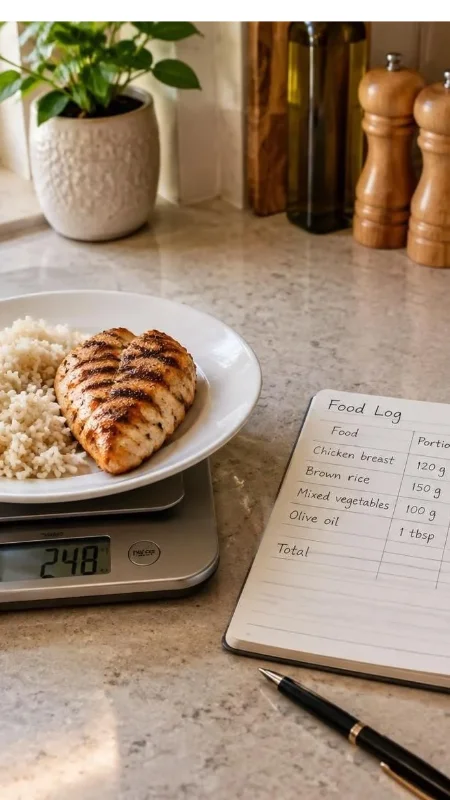
Gather a notebook or printed log, a pen, and a basic calculator if you’d rather not do multiplication in your head. A kitchen scale can help you measure portions consistently, but you can also use the household measures shown on a label, such as cups or pieces.
For packaged foods, use the Nutrition Facts label on the exact product. For plain foods, USDA FoodData Central is a reference for looking up nutrient information. Write down which source you used so you can check it later.
How to Count Macros Without an App
1. Choose the closest food entry
Start with the food as you actually ate it. For packaged food, record the brand and product name. For an unbranded food, choose a database entry that matches the food and its preparation as closely as possible. A restaurant meal without published nutrition information will be an estimate, so label it as one rather than treating it as exact.
2. Scale the label to your portion
Check the serving size first. Nutrition Facts values apply to the serving shown on the label, not automatically to the amount in your bowl or on your plate. The FDA also notes that serving size is not a recommendation of how much to eat.
Use this calculation:
Number of servings eaten = your portion ÷ label serving size
Then multiply each macro by that number.
For example, imagine a hypothetical label lists, per 30-gram serving, 4 grams of protein, 18 grams of total carbohydrate, and 3 grams of fat. If you eat 45 grams, you ate 1.5 servings:
| Macro | Per 30 g serving | For a 45 g portion |
|---|---|---|
| Protein | 4 g | 6 g |
| Total carbohydrate | 18 g | 27 g |
| Fat | 3 g | 4.5 g |
If the label uses a household measure, you can scale that too. For instance, a ¾-cup portion is 1.5 times a ½-cup serving. If the label also gives a gram weight and you have a scale, weighing can make the comparison more consistent.
3. Calculate values for plain, unpackaged foods
Some database entries list nutrients per 100 grams. To estimate the macros for your portion:
Your portion in grams ÷ 100 × the database value per 100 grams
For example, a 75-gram portion is 0.75 times the listed value per 100 grams. Apply that multiplier separately to protein, carbohydrate, and fat.
Pay attention to the food description. If you weigh a cooked item, choose a cooked entry; if you weigh it raw, choose a raw entry. FoodData Central descriptions can specify preparation state, and values and portion weights can vary between entries.
4. Add up the ingredients in a homemade recipe
For a mixed dish, record the amount of each ingredient and add its macros to the recipe total. Include ingredients that are easy to overlook, such as cooking oil, dressing, sauces, cheese, and toppings.
If the batch makes four equal portions, divide each recipe total by four. If portions aren’t equal, weigh the finished dish and the portion you serve; use the portion’s share of the finished batch to estimate its share of the recipe’s macros. If ingredients aren’t distributed evenly—for example, one serving contains more meat—record those components separately when practical.
5. Add each meal to your daily total
Write down what you ate, the amount, and the macros for that portion. At the end of the day, add the protein column, the carbohydrate column, and the fat column separately. A running total after each meal can make it easier to spot a missed snack or ingredient before you finish.
A Simple Paper Macro Log
Use one line per food, or per ingredient when a meal is homemade. These optional source marks make the figures easier to review:
- L: Nutrition Facts label
- U: USDA or another named food database
- E: Estimate, such as a restaurant meal without published nutrition information
| Meal or food | Portion and preparation | Source | Protein (g) | Total carbs (g) | Fat (g) |
|---|---|---|---|---|---|
| Breakfast | |||||
| Lunch | |||||
| Snack or drink | |||||
| Dinner | |||||
| Daily total |
If you often eat the same meals, keep a separate note with the ingredients and calculations. You can reuse it as a reference, then adjust the portion size when it changes.
Common Macro-Tracking Mistakes
Confusing a serving with your portion. A package may contain more than one serving, and your portion may be larger or smaller than the amount on the label. Multiply the listed macros by the number of servings you actually ate.
Counting a carbohydrate subcategory twice. On a U.S. Nutrition Facts label, total carbohydrate is shown along with subcategories such as fiber and sugars. Use total carbohydrate for a standard macro tally; don’t add fiber or sugars to it again. Saturated fat is part of total fat, not an additional macro.
Mixing raw and cooked weights. FoodData Central entries may specify whether a food is raw or cooked. Match the state of your weighed portion to the entry you use.
Forgetting small extras. Cooking oil, sauces, spreads, and drinks with added ingredients can contribute macros. Record them when they’re part of what you ate.
Treating estimates as exact. If a restaurant meal has no nutrition information, mark the entry as an estimate. Consistent assumptions are more useful than adding decimal places to uncertain numbers.
How Accurate Is Manual Macro Tracking?
Manual macro counting can help you organize food information, but the total is still an estimate. Food composition varies, database entries may represent different food samples or preparation states, and published values are rounded. USDA documentation notes that even database values can have small rounding differences.
Focus on using the same method consistently: choose a matching entry, measure or estimate the portion, and record what you used. The goal is a usable record—not a claim that every number exactly describes your plate.
When to Get Personalized Guidance
If you have a medical condition that affects your diet, ask your healthcare professional or registered dietitian to help set targets. For example, NIDDK says that people with chronic kidney disease may need individualized protein guidance.
Also pay attention to how tracking affects you. If it starts to fuel obsessive thoughts about food or weight, guilt after eating, anxiety, or restrictive behavior, pause and seek support from a qualified professional. NEDA identifies some of these experiences as potential warning signs during eating-disorder relapse.
Frequently Asked Questions
Can I count macros without a kitchen scale?
Yes. Use the household measures or piece counts on the label, or a consistent measuring cup. A scale can make portions easier to compare with gram-based information, but it isn’t the only way to keep a log.
How do I count carbohydrates from a U.S. food label?
Use the Total Carbohydrate line. Fiber and sugars are listed as subcategories; don’t add them to total carbohydrate a second time.
Do I need to track macros every day?
Not necessarily. Tracking is one way to organize nutrition information, not a requirement for everyone. If you have a personal target or medical nutrition plan, ask the professional who set it how and when to track.
The Takeaway
To count macros without an app, record each food and portion, use a label or suitable database entry, scale the numbers to the amount eaten, and add protein, carbohydrate, and fat separately. A paper log is enough to get started. Keep the figures in perspective: they’re practical estimates, not a reason to chase perfect numbers.
Disclaimer: This article is for general educational purposes and is not medical or professional advice. Please consult a qualified healthcare professional before making changes to your diet, exercise, or health routine. See our Medical Disclaimer.