
You’ve probably been there: you finish a set of crunches, your core is burning, and for a moment you feel like you’re doing everything right. Then you catch your reflection later—same midsection, same softness, same “why isn’t this working?” feeling.
That frustration is real, and it’s not because you’re lazy or “not made for abs.” Most people simply get sold the wrong plan: endless ab exercises without the two things that actually reveal definition—smart nutrition and effective full-body training. If you want a visible six-pack (or even just a tighter, athletic midsection), you need a clear approach that matches how the body works.
Table of Contents
This guide walks you through exactly that—how to develop abs with the right diet and training, with practical steps you can start using today.
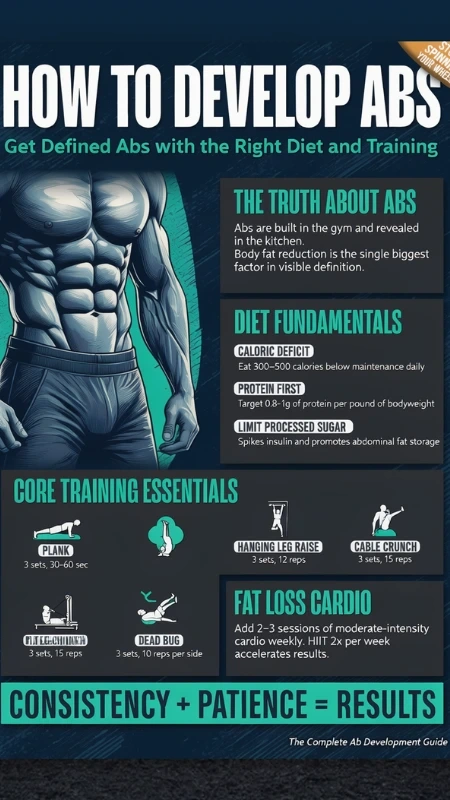
What “Defined Abs” Really Means (and Why You Can’t Force Them With Crunches)
Abs are built—and then revealed
Your abs are muscles, just like your glutes or biceps. You can strengthen them and make them thicker. But seeing them clearly is mostly about lowering body fat so the muscle shows through.
That’s why someone can do hundreds of sit-ups and still not look “cut.” Stronger abs are great, but they’re not magic. If there’s a layer of fat over them, they’ll stay hidden.
Key truth: you can’t spot-reduce fat from your belly. Targeted fat loss has been repeatedly shown to be minimal at best in controlled research (a common reference point is the American Council on Exercise’s summaries and multiple peer-reviewed studies on spot reduction). You can train your abs directly, but fat loss happens systemically.
Rough body fat ranges where abs start showing
This varies with genetics, muscle mass, and where you store fat, but these are common ranges:
- Men: outlines often appear around 12–15%, clearer definition around 10–12%
- Women: outlines often appear around 18–22%, clearer definition around 16–20%
(General ranges align with widely used body composition guidance such as ACSM/clinical references.)
If you’re not there yet, don’t take it personally—take it as information. Your plan just needs to prioritize the actions that move you toward that range while keeping your body strong and healthy.
How to Develop Abs With Nutrition: The Diet Strategy That Actually Reveals Them
If your goal is defined abs, nutrition isn’t “extra.” It’s the main switch that turns visibility on.
1) Create a sustainable calorie deficit (without crashing)
Fat loss requires a calorie deficit—meaning you burn more than you eat over time.
A realistic starting point for many people is a 250–500 calorie daily deficit, which often produces steady progress without ruining your energy or training.
How you know your deficit is working:
- Your weekly average weight trends down (not necessarily every day)
- Your waist measurement shrinks over time
- Your gym performance is mostly stable (or improving slowly)
Tip: daily scale weight jumps around because of water, salt, stress, sleep, and carbs. Track trends, not single weigh-ins.
2) Hit protein like it’s your job (because your abs are muscle)
When you diet, your body can lose both fat and muscle. Protein helps you keep more muscle so you look firmer as you lean out.
A widely cited range for active people cutting fat is 1.6–2.2 g of protein per kg of bodyweight per day (often referenced in sports nutrition research and ISSN position stands).
Easy ways to raise protein without overthinking:
- Add Greek yogurt or cottage cheese daily
- Use lean meats or tofu/tempeh at lunch and dinner
- Add a scoop of whey (or a plant blend) if you struggle to reach your targe
3) Balance carbs and fats so you can train hard and stay consistent
There’s no one macro split that supports abs. The “best” split is the one you can follow while training well.
A practical starting structure:
- Protein: 30–40% of calories
- Fat: 20–30% of calories
- Carbs: the remainder (often the easiest lever for energy and performance)
Carbs help you push harder in lifting sessions. Fats support hormone production and help meals feel satisfying. If you slash either too aggressively, you often end up tired, cranky, and inconsistent—which is where most “abs journeys” fall apart.
4) Choose foods that make dieting feel easier
You don’t need perfect eating. You need repeatable meals that keep you full.
Focus your grocery cart on:
- Lean proteins: chicken breast, turkey, tuna, salmon, eggs/egg whites, tofu, tempeh
- High-volume produce: berries, spinach, broccoli, cauliflower, zucchini, peppers
- Smart carbs: oats, rice, potatoes, beans/lentils, whole-grain bread (portioned)
- Fats (measured): olive oil, avocado, nuts, nut butters
Your simple “abs plate” template:
- 1–2 palms of protein
- 1 fist of carbs (more on training days if needed)
- 2 fists of vegetables
- 1 thumb of fat
5) Hydration and sodium: how to avoid the “bloated belly” trap
Sometimes you’re leaner than you think—you’re just holding water.
Common reasons your midsection looks softer:
- Big swings in sodium intake
- Poor sleep
- High stress
- Very high fiber increase too quickly
- Hard training + inflammation
You don’t need a cleanse. You need consistency:
- Keep sodium intake steady day to day
- Drink enough water (pale yellow urine is a decent cue)
- Add potassium-rich foods (bananas, potatoes, spinach)
- Increase fiber gradually, not over time
Abs-Friendly Meals You’ll Actually Want to Repeat (With Ingredient Tables)
Below are three simple, high-protein options you can cycle through to make your diet easier to stick to.
Recipe 1: High-Protein Greek Yogurt Bowl (5 minutes)
| Ingredient | Amount | Notes |
|---|---|---|
| Plain Greek yogurt (0–2%) | 250 g | Protein base |
| Mixed berries | 100 g | Fiber + flavor |
| Chia seeds | 1 tbsp | Adds fiber and texture |
| Honey (optional) | 1 tsp | Skip if cutting hard |
| Cinnamon | To taste | Big flavor for minimal calories |
Why it works: fast, filling, and easy to track.
Upgrade option: mix in 1 scoop protein powder if your daily protein is low.
Recipe 2: Lean “Abs Lunch” Meal Prep Bowl
| Ingredient | Amount | Notes |
|---|---|---|
| Chicken breast (cooked) | 150–200 g | Swap: tofu/lean beef |
| Cooked rice or quinoa | 150 g | Adjust to your calorie target |
| Mixed vegetables | 200–300 g | Frozen is fine |
| Olive oil | 1 tsp | Add after cooking |
| Salsa or low-cal sauce | 2–4 tbsp | Keeps it enjoyable |
Why it works: you get protein + volume + a measured carb portion that supports training.
Recipe 3: High-Protein Egg & Veg Breakfast
| Ingredient | Amount | Notes |
|---|---|---|
| Whole eggs | 2 | Flavor + nutrients |
| Egg whites | 150 g | Boost protein easily |
| Spinach + mushrooms | 2 cups | Volume and micronutrients |
| Salt & pepper | To taste | Keep sodium consistent |
| Feta (optional) | 15 g | Add if calories allow |
Why it works: hearty, not sugary, and it keeps cravings quieter later in the day.
How to Develop Abs With Training: What to Do in the Gym (and What to Stop Doing)
The common mistake: ab marathons
If your plan is “finish every workout with 15 minutes of random ab circuits,” you’ll get tired abs… not necessarily defined abs.
Your core responds well to the same principles as other muscles:
- progressive overload
- good technique
- adequate recovery
- enough total training stimulus
Strength training: your foundation for a lean, athletic look
If you want abs that show, you also want a body that’s muscular enough to look defined at a healthier body fat level.
Prioritize compound movements:
- Squats or leg press
- Deadlifts or Romanian deadlifts
- Bench press or push-ups
- Rows and pull-ups/lat pulldowns
- Overhead press
Aim for 3–5 lifting sessions per week, depending on your schedule and recovery. You don’t need to be perfect—you need to be consistent.
The best ab exercises for definition (organized by function)
Instead of doing ten different moves poorly, build your ab training around patterns:
- Anti-extension (resist arching):
- Ab wheel rollout
- Dead bug
- Stability ball rollout
- Anti-rotation (resist twisting):
- Pallof press
- Cable holds/chops (controlled)
- Loaded flexion (build thickness):
- Cable crunch
- Weighted decline sit-up
- Hip flexion (use carefully):
- Hanging knee raise
- Reverse crunch
Programming that works:
- Train abs 2–4 times per week
- Pick 2–3 exercises per session
- Use 6–12 reps for weighted moves, 8–15 for controlled bodyweight
- Track performance and progress (more reps, more load, better control)
If you’re not tracking, you’re guessing—and guessing is slow.
Cardio for abs: use it like a tool, not punishment
Cardio isn’t mandatory, but it can make fat loss easier.
What tends to work best:
- NEAT (daily steps): aim for 7,000–10,000 steps/day, building gradually
- 2–4 cardio sessions/week:
- LISS (steady pace) for 20–40 minutes, or
- short intervals if your recovery is solid
If HIIT leaves you exhausted and ravenous, it’s not “weakness.” It’s feedback. Choose the version you can recover from.
A Simple Weekly Plan (Diet + Training) to Reveal Abs
Sample weekly training split
Use this as a template and adjust around your life:
- Day 1: Upper body + Abs (anti-extension + loaded flexion)
- Day 2: Lower body + 20–30 minutes steady cardio
- Day 3: Steps + mobility (active recovery)
- Day 4: Upper body + Abs (anti-rotation + raises)
- Day 5: Lower body + optional intervals (if recovery is good)
- Day 6: Steps + easy cardio (optional)
- Day 7: Rest
Weekly nutrition checklist (simple, effective)
- Maintain a 250–500 calorie deficit on average
- Hit your protein target daily
- Get 25–35 g fiber/day (increase gradually)
- Keep hydration and sodium consistent
- Eat 80–90% whole foods, keep 10–20% flexible so you don’t rebound
That last point matters: the best diet is the one you can live with.
Recovery: The Missing Piece in Most “Abs Plans”
Sleep and stress affect your appetite more than you think
When sleep is short, cravings get louder and your patience gets shorter. Stress does similar damage. Even if you don’t want to think about hormones, the real-world effect is obvious: you snack more, move less, and train with less intensity.
Aim for:
- 7–9 hours of sleep most nights
- a consistent bedtime when possible
- a wind-down routine (dark room, less late-night scrolling, lighter meals if reflux/bloat hits)
Rest days keep your training effective
Abs recover quickly, but they still need recovery—especially if you’re lifting heavy and dieting.
A good rule: train your core with intent, then leave it alone long enough to improve next time.
Common Mistakes That Keep Your Abs Hidden
If progress feels stuck, check these first:
- You’re eating “clean,” but portions are bigger than you think
- You’re doing high-rep ab burnouts with no progressive overload
- You cut calories too hard, then binge on weekends
- Your daily steps swing wildly (NEAT inconsistency is sneaky)
- You measure progress by the scale only (ignore waist/photos at your own risk)
- You expect abs to look sharp 24/7 (water retention is normal)
Fix the basics, and the results usually restart.
How to Track Progress (So You Don’t Quit Right Before It Works)
Use a simple tracking system that reflects reality:
- Waist measurement: once per week, same time of day
- Progress photos: same lighting, same pose, every 2–4 weeks
- Scale trend: use a weekly average, not a daily mood swing
- Strength markers: are you maintaining load or reps on big lifts?
Realistic timelines
If you lose fat at roughly 0.5–1% of your bodyweight per week, you’re in a sustainable zone for many people. Visible changes often show up within 4–8 weeks, but a noticeably defined midsection can take longer depending on your starting point.
You’re not behind—you’re just in the middle of the process.
FAQ: How to Develop Abs (Clear Answers)
How to develop abs without losing muscle?
Keep your calorie deficit moderate, lift consistently, and hit protein in the 1.6–2.2 g/kg/day range. If your strength is falling fast, your deficit is likely too aggressive.
How to develop abs fast in a safe way?
You’ll move quickest by tightening what you can control: track food for 2–3 weeks, increase steps, keep lifting heavy, and sleep more. “Fast” still needs structure—crash dieting usually backfires.
How to develop abs if you hate cardio?
Walk more. Steps are underrated, joint-friendly, and surprisingly effective when you’re consistent. Add short sessions of easy cycling or incline walking if you want extra burn without misery.
How often should you train abs to develop abs definition?
Most people do well with 2–4 focused ab sessions per week, using progressive overload and clean technique.
Why are your abs strong but not visible?
Usually it’s body fat, water retention, or inconsistent dieting (often weekend calories). Strong abs are a great start—visibility comes from the overall plan.
Your Next Step: Make This Simple and Actually Start
You don’t need a perfect routine. You need a repeatable one.
Here’s your quick action plan for this week:
- Set a modest calorie deficit and hit your protein target daily
- Lift 3–4 times and train abs 2–3 times with progression
- Walk enough to hit a step goal you can maintain
- Track waist + photos for real feedback
If you want, share your current routine (training days, step average, and a typical day of eating) and your goal timeline—and you’ll get a clearer suggestion for what to adjust first.
Disclaimer: This article is for general educational purposes and is not medical or professional advice. Please consult a qualified healthcare professional before making changes to your diet, exercise, or health routine. See our Medical Disclaimer.