
Creating a Nutrition Facts label is an important step when preparing packaged food products for sale. Whether you make granola, sauces, baked goods, snacks, or other foods, a clear and accurate label helps customers understand what is in your product.
Nutrition labeling software can simplify the process by organizing ingredient information, estimating nutrient content, and formatting a label. However, using a tool does not automatically make a label compliant with every applicable food-labeling rule. Requirements depend on the product, where it is sold, and whether any exemptions apply.
Table of Contents
This guide explains how to prepare a Nutrition Facts label, what information you may need, how to avoid common mistakes, and where to find reliable resources.
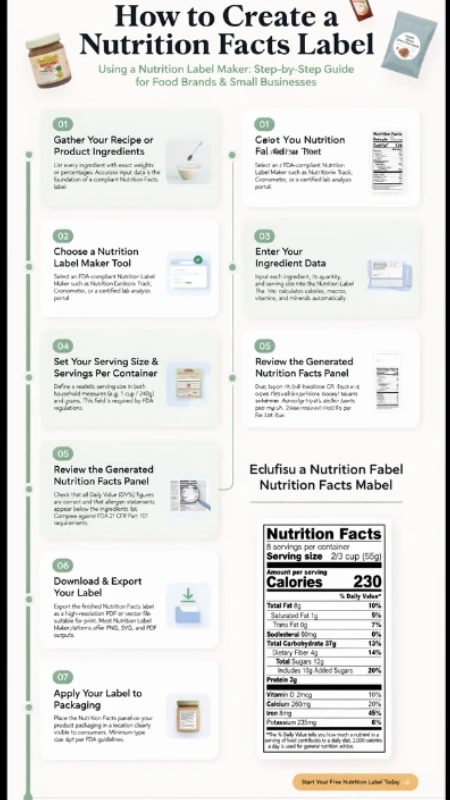
What Is a Nutrition Label Maker?
A nutrition label maker is a software tool or online service that helps food producers prepare nutrition information for packaged products.
Depending on the tool, its features may include:
- Entering ingredients and their quantities.
- Estimating calories and nutrient values.
- Calculating nutrition information per serving.
- Adjusting serving sizes and recipe yields.
- Formatting a Nutrition Facts panel.
- Exporting a label for review or printing.
Some tools use nutrient databases, while others may support laboratory results or additional labeling features. Their capabilities vary, so review what each tool actually provides before choosing one.
A nutrition label maker can save time, but the person or business selling the food remains responsible for checking the information and determining which labeling requirements apply.
What Information Appears on a Nutrition Facts Label?
For products covered by U.S. Food and Drug Administration (FDA) nutrition-labeling rules, the Nutrition Facts panel generally includes information such as:
- Serving size.
- Servings per container, when applicable.
- Calories per serving.
- Total fat, saturated fat, and trans fat.
- Cholesterol and sodium.
- Total carbohydrate, dietary fiber, total sugars, and added sugars.
- Protein.
- Vitamin D, calcium, iron, and potassium.
- Percent Daily Value (%DV), where required.
The exact format and requirements can vary according to the product and applicable rules. Certain foods may qualify for exemptions, but an exemption should never be assumed without checking the relevant conditions.
Also, remember that the Nutrition Facts panel is not the same as the ingredient list or allergen declaration. These are separate parts of food labeling, and each may have its own requirements.
For official information, visit the FDA’s Nutrition Facts Label resources.
How to Create a Nutrition Facts Label Step by Step
Step 1: Prepare Your Complete Recipe
Start by writing down every ingredient used in your product.
Measure ingredients by weight whenever possible, and record the quantity of each ingredient. For example, if you are preparing granola, your ingredient list might include oats, nuts, seeds, oil, and a sweetener.
Record the exact ingredients and quantities used in the batch. If you use different brands or substitute an ingredient, review whether the change affects the nutritional calculation.
Accurate recipe information is the foundation of a useful nutrition estimate.
Step 2: Choose a Reliable Nutrient Data Source
To estimate the nutritional content of a recipe, you need information about the nutrients in its ingredients.
One useful resource is USDA FoodData Central, which provides food composition data for many foods and ingredients.
When selecting a database entry, make sure it matches your ingredient as closely as possible. For example, raw oats, cooked oats, sweetened oats, and flavored oat products may have different nutritional values.
Packaged ingredients can also vary between brands. Where appropriate, use the manufacturer’s nutrition information for the exact ingredient you purchase.
Database values are estimates and may not perfectly represent your finished product.
Step 3: Enter Ingredients and Quantities Into the Software
Choose a nutrition labeling tool that supports your type of food and the market where you plan to sell it.
Enter each ingredient and its quantity carefully. Check that the selected database entry matches the ingredient, including whether it is raw, cooked, dried, or prepared.
The software may then estimate the combined nutrient content of the recipe.
Before continuing, check for:
- Missing ingredients.
- Incorrect quantities or measurement units.
- Duplicate entries.
- Incorrect ingredient matches.
- Data that does not reflect the actual product.
A small error in the recipe can affect the final nutrition estimate.
Step 4: Determine the Finished Batch Weight and Serving Size
Serving size is an important part of nutrition labeling. Do not choose a serving size simply because it makes the nutrition numbers look better.
First, determine the finished product’s weight. Cooking, baking, drying, or other processing can change the amount of water in a product and affect its final weight.
For example, a baked product may weigh less than the combined weight of its raw ingredients because moisture evaporates during baking.
Next, determine the appropriate serving size under the rules that apply to your product. For U.S. packaged foods, the FDA has specific requirements for serving sizes and how they are expressed.
If you are unsure which serving size applies, consult the relevant FDA guidance or a qualified food-labeling professional.
Step 5: Review the Nutrient Calculations
After entering the recipe and serving size, review the estimated nutrient values before generating the label.
Check the following:
- Calories per serving.
- Fat, carbohydrate, and protein values.
- Fiber and sugar information.
- Sodium and other relevant nutrients.
- Vitamins and minerals, where applicable.
- Serving size and units.
- Percent Daily Values, where required.
Do not assume the software has selected the correct values or applied every relevant rule. U.S. Nutrition Facts labels follow specific formatting, rounding, and calculation requirements.
Review the current FDA guidance and applicable regulations before using the output on a product for sale.
Step 6: Generate and Check the Label
Once you have reviewed the data, use the software to create the Nutrition Facts panel.
Check the finished label for readability, layout, serving information, and consistency with the actual product. Confirm that the tool supports the label format and market you need.
Before printing or publishing the label, review the complete package, not just the Nutrition Facts panel. Depending on your product, you may also need an ingredient list, allergen information, net quantity statement, business information, or other required details.
If you sell food in the United States, consult the FDA’s official labeling resources. If you sell in another country, check the rules of that market as well.
Common Mistakes to Avoid
1. Using Inaccurate Ingredient Quantities
Guessing ingredient amounts or entering the wrong measurement units can produce misleading nutrient estimates.
How to avoid it: Weigh ingredients carefully and save the final recipe used for the calculation.
2. Selecting the Wrong Database Entry
Two ingredients that sound similar may have different nutrient profiles. Raw, cooked, sweetened, and processed versions are not always interchangeable.
How to avoid it: Match the database entry to the actual ingredient and use brand-specific data when appropriate.
3. Ignoring Changes During Food Preparation
Cooking and processing can change the final product’s weight and composition. Calculating nutrition from the original ingredient weights alone may not accurately describe the finished product per serving.
How to avoid it: Record the finished batch weight and use a calculation method suitable for your product and preparation process.
4. Copying Another Product’s Nutrition Label
A similar product from another business may use different ingredients, quantities, suppliers, or preparation methods.
How to avoid it: Calculate the information for your own product rather than copying a competitor’s label.
5. Assuming the Software Supports Compliance
A professionally formatted label can still contain inaccurate nutrient information or omit required labeling details.
How to avoid it: Verify the data, check current regulations, and seek qualified advice when necessary.
6. Forgetting Ingredient and Allergen Information
The Nutrition Facts panel does not replace the ingredient list or other required declarations.
How to avoid it: Review all applicable labeling requirements for your product. The FDA provides information about food allergies and allergen labeling.
How to Choose the Right Nutrition Labeling Software
Before choosing a tool, consider your product, budget, and labeling needs.
Look for software that offers:
- A suitable ingredient database: It should support the ingredients used in your recipes.
- Recipe and batch calculations: You should be able to enter ingredient quantities and finished batch weights.
- Serving-size controls: The tool should let you enter the appropriate serving information.
- Current labeling features: Check whether the software is maintained and supports the rules relevant to your market.
- Clear output: The generated panel should be readable and suitable for review.
- Data transparency: You should be able to understand where nutrient estimates come from.
- Record keeping: Saving recipes, ingredient details, calculations, and label versions makes future updates easier.
- Support when needed: For complex products, access to knowledgeable labeling support can be valuable.
Compare tools based on their actual features rather than relying only on marketing claims. A tool that works well for a simple recipe may not be suitable for every packaged food.
When Should You Consider Laboratory Testing?
Nutrient databases can be useful for estimating the nutrition of a recipe, but estimates may not always represent the finished product precisely.
Laboratory analysis may be worth considering when product variability, business requirements, customer expectations, or applicable regulations make more specific data important. The appropriate approach depends on the food, the nutrients being declared, and the claims made about the product.
For example, products with substantial variation between batches may need a more careful assessment than a simple recipe made consistently from standardized ingredients.
Laboratory testing does not remove the need to review labeling rules, and it should be performed using an appropriate method for the product and intended purpose.
Tips for Keeping Nutrition Labels Accurate
Once you have prepared a label, keep the supporting information organized.
- Save the recipe and ingredient quantities.
- Record ingredient brands or specifications when relevant.
- Keep a copy of the nutrient data and calculations.
- Record the finished batch weight and serving-size assumptions.
- Save the final label version and the date it was reviewed.
- Reassess the label when ingredients, suppliers, recipe quantities, or preparation methods change.
- Check for relevant regulatory updates before making changes to packaging.
Good records help you understand how the label was prepared and make future reviews easier.
Frequently Asked Questions
Is a nutrition label maker enough to create a compliant label?
Not by itself. A nutrition label maker can help calculate and format information, but the result must still be checked for accuracy and compliance with applicable requirements. The correct approach depends on the product and the market where it will be sold.
Can I create a Nutrition Facts label manually?
It may be possible to calculate and format nutrition information manually, but this requires reliable ingredient data and a good understanding of the relevant rules. A suitable software tool can simplify the process, although it does not eliminate the need for verification.
Is USDA FoodData Central free to use?
USDA FoodData Central is a public resource for food composition information. It can help you find nutrient data for many foods and ingredients. You should still make sure the selected entry matches your actual ingredient.
Do all packaged foods need a Nutrition Facts label in the United States?
Not necessarily. Some products or businesses may qualify for specific exemptions, while others must follow applicable nutrition-labeling requirements. Eligibility depends on the relevant rules and circumstances. Check current FDA guidance before relying on an exemption.
Should I use laboratory testing or database calculations?
The appropriate method depends on your product, how consistently it is made, the information you need, and applicable requirements. Database calculations can provide estimates, while laboratory testing can provide analytical results for tested samples. A qualified professional can help determine which approach is suitable.
Can I use the same nutrition label in every country?
No. Nutrition-labeling rules differ between countries and markets. A label prepared for sale in the United States may need changes before it can be used elsewhere.
Conclusion
Creating a Nutrition Facts label involves more than entering ingredients into a nutrition label maker. You need accurate recipe information, appropriate nutrient data, a suitable serving size, careful review of calculations, and an understanding of the labeling requirements for your product.
Nutrition labeling software can make the process more organized and efficient, especially when you keep clear records and review each result carefully. However, it should be treated as a tool rather than a supports of compliance.
For food products sold in the United States, start with the FDA’s official Nutrition Facts Label resources and use USDA FoodData Central as one possible source of ingredient nutrient information. When requirements are unclear, consider consulting a qualified food-labeling professional.
Disclaimer: This article provides general educational information and is not legal or regulatory advice. Always verify current requirements for your specific product and sales market.
Disclaimer: This article is for general educational purposes and is not medical or professional advice. Please consult a qualified healthcare professional before making changes to your diet, exercise, or health routine. See our Medical Disclaimer.